
Giving Voice to the Sublime
Poet Luray Gross explains the world around her with fierceness, lyricism, and unflinching honesty.
As a young girl growing up on a working dairy farm north of Doylestown, Luray Gross was enamored with the flora and fauna of Bucks County. Being part of an artistic and church-going family stoked her interest in “rhythmic and musical language.” As she grew older, she started writing poetry to better understand her connection to the natural world.
“There was always a part of me that I didn’t understand and nobody else knew about,” she recalls. “In reading both fiction and poetry, I would find myself. The way words were put together with artfulness spoke to me from the time when I was young.”
In college, Gross majored in English and minored in education. The works of contemporary poets such as Robert Bly, Richard Wilbur, and William Carlos Williams opened her eyes to “the possibilities of form and freedom.” She also got comfortable with saying, “I am a poet.” She went on to become an English teacher, and eventually was named a Distinguished Teaching Artist by the New Jersey State Council on the Arts. In 2002, she earned another prestigious title: Bucks County Poet Laureate.
Gross continues to feed her appetite for teaching through the VOLTA Center for Writing Arts at Bucks County Community College. She enjoys being part of an organization committed to helping students and community members express themselves through the written word.
Although her earliest writings focused primarily on nature, her poetry has evolved to “take on more of the world now”—fierce, lyrical, and precise, as well as unapologetically honest. Her published works include the collections Lift (2019) and With This Body (2023). She’s currently working on her next collection, which will likely include poems influenced by memories of her late mother, who would have turned 99 this year.
Q&A
What do you consider the role or even the responsibility of a poet at this time in the world?
Your responsibility is to be honest. It doesn’t mean that what you would say would be the truth, but honest to what you observe, honest to what you feel, honest to what you want to say. … It’s important to be honest with your writing and to share the work, not just your own, but to bring artfulness of any kind to other people. In art, whether deliberate or accidental, our responsibility is to speak, but not just with our own voice.
What do you consider the role or even the responsibility of a poet at this time in the world?
Your responsibility is to be honest. It doesn’t mean that what you would say would be the truth, but honest to what you observe, honest to what you feel, honest to what you want to say. … It’s important to be honest with your writing and to share the work, not just your own, but to bring artfulness of any kind to other people. In art, whether deliberate or accidental, our responsibility is to speak, but not just with our own voice.
Beyond your interest in nature, what are some of the early experiences that compelled you to start reading and writing poetry as a tool for self-expression?
One early experience that has stayed with me, and which I think has led to the range my poems can take, either individually or as a whole, was reading Robert Bly’s Leaping Poetry: An Idea with Poems and Translations. In the introduction, he discusses the ancient notion of the poet flying from one world to the other on the wings of dragon smoke. In another portion of the essay, he presents this metaphor: Some poets are like the hiker who gets to a canyon, carefully climbs down, builds a boat, rows across the river, climbs up, and proceeds. The leaping poet arrives at the canyon, takes a breath, and flies across. This metaphor has helped me both as a reader and as a writer, allowing me to welcome the associative functions of the mind, often dreamlike, and always in tune with the idea that all things are connected. So when there is a leap in my imaging, thinking, or feeling, I try to welcome that leap.
One early experience that has stayed with me, and which I think has led to the range my poems can take, either individually or as a whole, was reading Robert Bly’s Leaping Poetry: An Idea with Poems and Translations. In the introduction, he discusses the ancient notion of the poet flying from one world to the other on the wings of dragon smoke. In another portion of the essay, he presents this metaphor: Some poets are like the hiker who gets to a canyon, carefully climbs down, builds a boat, rows across the river, climbs up, and proceeds. The leaping poet arrives at the canyon, takes a breath, and flies across. This metaphor has helped me both as a reader and as a writer, allowing me to welcome the associative functions of the mind, often dreamlike, and always in tune with the idea that all things are connected. So when there is a leap in my imaging, thinking, or feeling, I try to welcome that leap.
Do you sit down to a blank page or a computer screen and see what comes out, or do you sit with an idea for a while before you try to write it out?
I’m more like the former. If nothing’s coming, I try to write about the weather or what’s in front of me. Other people’s writing has opened doors for me—it could be a phrase or a complete sentence—so it’s a matter of allowing myself to leap off other people’s use of language. … I have learned to let the poem try to speak. It doesn’t always happen; a poem is written more by listening than by will, with listening being a metaphor for all of the senses. Look beyond yourself, feel beyond yourself. You can’t help but be in the center.
I’m more like the former. If nothing’s coming, I try to write about the weather or what’s in front of me. Other people’s writing has opened doors for me—it could be a phrase or a complete sentence—so it’s a matter of allowing myself to leap off other people’s use of language. … I have learned to let the poem try to speak. It doesn’t always happen; a poem is written more by listening than by will, with listening being a metaphor for all of the senses. Look beyond yourself, feel beyond yourself. You can’t help but be in the center.
Does poetry help you contend with the horrors of the world, or does sitting with them that intently deepen the pain?
It doesn’t deepen the pain. It probably helps me put little bits of it in a container. The book The Well Wrought Urn [by Cleanth Brooks] is about the craft of poetry, and it supposes the poem, like a song, like a painting, is a way to contain some part of what is too beautiful to express, or too tragic to express—they’re partners, they go together—and give it some form. Poems are containers for some parts of our experience.
It doesn’t deepen the pain. It probably helps me put little bits of it in a container. The book The Well Wrought Urn [by Cleanth Brooks] is about the craft of poetry, and it supposes the poem, like a song, like a painting, is a way to contain some part of what is too beautiful to express, or too tragic to express—they’re partners, they go together—and give it some form. Poems are containers for some parts of our experience.
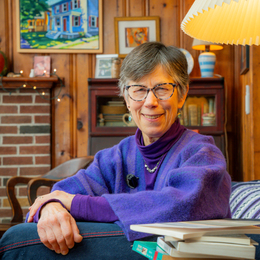
Photo by Jody Robinson
Published (and copyrighted) in Suburban Life, November 2025.