

Give and Take
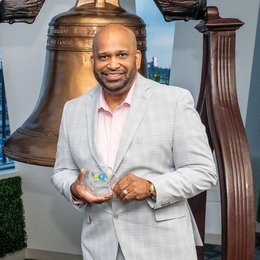
Mark Wainwright, founder of the nonprofit It Takes a Village to Feed One Child, has devoted his life to making a difference.
Mark Wainwright was running a pizza shop in Delaware County when a woman walked in and, in his words, “changed my life forever.”
“She was from the elementary school down the street and she said, ‘Do you mind showing the kids how to make pizzas?’” he recalls. “I thought: Why not? I bought some small aprons and some dough balls, and we made it happen. I remember how much [the children] messed up the store, but I also remember their smiles.”
The same woman later returned with a question: “Did you ever think about doing a school lunch program?” The interaction ultimately led Wainwright to discover what he calls “my life’s passion.” In 2017 he founded It Takes a Village to Feed One Child, a King of Prussia-based nonprofit powered by a $5 million annual budget and a noble mission: “to improve community well-being through a variety of support programs, advocacy, and outreach projects that focus on achieving positive, long-term change.” The organization provides an estimated 3 million meals and snacks annually to children, older adults, and at-risk individuals through more than 100 centers in Philadelphia and surrounding counties, as well as parts of South Jersey and Delaware.
Wainwright, a West Philadelphia native who now lives in Ridley Park, uses his expertise in leadership and entrepreneurship, as well as banking, lending, and real estate, to lead the nonprofit forward. His efforts have not gone unnoticed. Last year the Chamber of Commerce for Greater Philadelphia honored It Takes a Village to Feed One Child with a Civic 50 Greater Philadelphia Award for its social impact, alongside the likes of Children’s Hospital of Philadelphia, Independence Blue Cross, and West Chester University. While he appreciates the recognition, he gets more satisfaction out of seeing his labors improve the lives of others.
Q&A
Community involvement seems to be the throughline in your career. When and why did you first want to get involved in the business of helping others?
It started very early. I have three older brothers, and I grew up in a single-parent household in West Philadelphia. I was an eyewitness to my mom and how she helped the entire block. She worked for City Hall as a business revenue investigator, and when she went shopping, she bought for us and for the other children on the block. She was able to get resources into a community that really needed them. I never forgot that.
Community involvement seems to be the throughline in your career. When and why did you first want to get involved in the business of helping others?
It started very early. I have three older brothers, and I grew up in a single-parent household in West Philadelphia. I was an eyewitness to my mom and how she helped the entire block. She worked for City Hall as a business revenue investigator, and when she went shopping, she bought for us and for the other children on the block. She was able to get resources into a community that really needed them. I never forgot that.
The nonprofit provides millions of meals per year to people who face hunger and food insecurity. What are the biggest challenges you face in your work, as well as the opportunities for growth?
Interestingly enough, one of our biggest challenges has been a lack of exposure. We’re often told we’re the best-kept secret. The current climate keeps me up at night, too. … As for opportunities for growth, we grow every month because centers keep calling us. We have also done a lot of networking to pick up valuable partnerships with organizations like Mighty Writers. The word FEED in our name is an acronym for Fostering Enrichment and Empowerment through Development. We have a whole enrichment program with things we do to address with children, focusing on things like antibullying and skills enhancement. We’re starting to roll out those initiatives by partnering with other organizations.
Interestingly enough, one of our biggest challenges has been a lack of exposure. We’re often told we’re the best-kept secret. The current climate keeps me up at night, too. … As for opportunities for growth, we grow every month because centers keep calling us. We have also done a lot of networking to pick up valuable partnerships with organizations like Mighty Writers. The word FEED in our name is an acronym for Fostering Enrichment and Empowerment through Development. We have a whole enrichment program with things we do to address with children, focusing on things like antibullying and skills enhancement. We’re starting to roll out those initiatives by partnering with other organizations.
Your mother passed away in 2015, so she didn’t get to see what you’ve built. What would she think of the work you’re doing now?
Two of my older brothers attended our last Hunger Village Awards, which is our annual fundraising event, and when they saw what we were doing, they said, “Mom would be so proud of you.” She always supported me and showed me unconditional love. The one regret I have is that she wasn’t here to see me at my peak. She left in 2015, and then I lost my father, who I developed a great relationship with later in life. He died in 2017. My grandmother who jumped in to help raise me, she passed away before my mom did. Those were the three most important people in my life.
Two of my older brothers attended our last Hunger Village Awards, which is our annual fundraising event, and when they saw what we were doing, they said, “Mom would be so proud of you.” She always supported me and showed me unconditional love. The one regret I have is that she wasn’t here to see me at my peak. She left in 2015, and then I lost my father, who I developed a great relationship with later in life. He died in 2017. My grandmother who jumped in to help raise me, she passed away before my mom did. Those were the three most important people in my life.
How do you spend your time away from the work?
In this space, you never get a break. There are emergency crises and emergency closures, and those emails come in rapid fire. Even though we set boundaries, those emails still come in. I love football, and I’ll probably get emails during the Super Bowl. … I try to find balance. We have a staff of 13, and I’m getting better at delegating. I would stay [at work] until 10 or 11 at night, because this is my happy space. When I’m not here, I’m getting into my car and going to Macy’s and walking around or getting an ice cream or a soft pretzel. Otherwise I like to be at home with my children and my wife. My kids are young adults now, but I still want to be there for them.
In this space, you never get a break. There are emergency crises and emergency closures, and those emails come in rapid fire. Even though we set boundaries, those emails still come in. I love football, and I’ll probably get emails during the Super Bowl. … I try to find balance. We have a staff of 13, and I’m getting better at delegating. I would stay [at work] until 10 or 11 at night, because this is my happy space. When I’m not here, I’m getting into my car and going to Macy’s and walking around or getting an ice cream or a soft pretzel. Otherwise I like to be at home with my children and my wife. My kids are young adults now, but I still want to be there for them.
Photo courtesy of It Takes a Village to Feed One Child
Published (and copyrighted) in Suburban Life, February 2026.