
Restoring a Piece of the Past
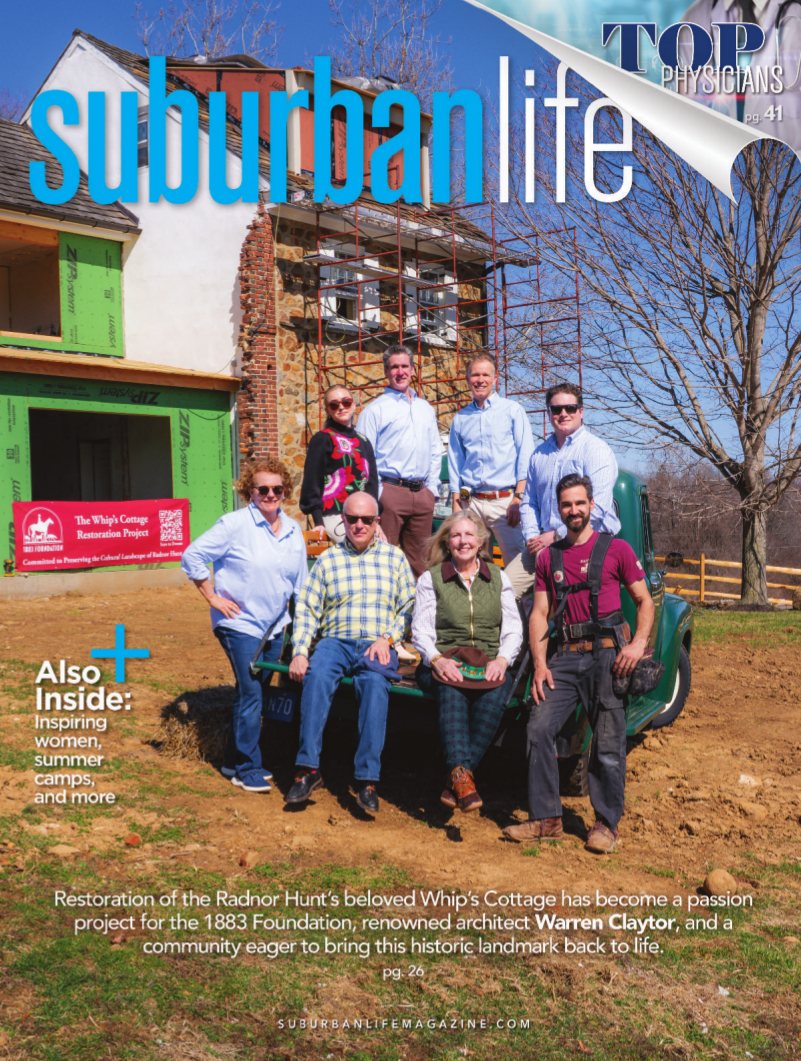
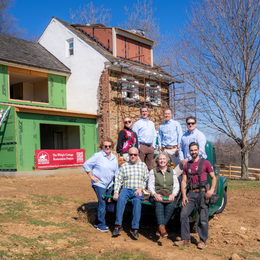
Restoration of the Radnor Hunt’s beloved Whip’s Cottage has become a passion project for The 1883 Foundation, renowned architect Warren Claytor, and a community eager to bring this historic landmark back to life.
Growing up in an old Radnor farmhouse helped Warren Claytor develop a deep admiration for everyone and everything that came before him. Besides coming of age in a region of Pennsylvania so rich with history, he was raised with a strong sense of community and the desire to give back whenever he could.
Both aspects of his upbringing go a long way in explaining his role in a special project currently underway in Chester County.
The 1883 Foundation is a 501(c)3 organization that was formed in 2021 to advance the public’s awareness of Radnor Hunt, the oldest continuously active fox hunt in the United States. As part of its mission to preserve and enhance the historic structures, landscape, archives, and equine and equestrian artifacts of Radnor Hunt, the nonprofit started raising funds to renovate a historic building on the club’s Willistown Township campus: the 1742 Benjamin Hibberd House, also known as the Whip’s Cottage, which had suffered extensive water damage after a frozen pipe burst.
As an architect for nearly three decades, a passionate supporter of historical preservation, and a longtime volunteer at Radnor Hunt, Claytor was thrilled to join the project’s team. He appreciates the fact that ensuring the proper preservation of Whip’s Cottage has become a true community effort.
“It’s such a nice Chester County and Main Line story about bringing this historic structure back, but also about the way that the community has been really helpful in donating to the project,” he says. “I have a great appreciation for conservation, land preservation, and the landowners, and all of this is possible only because of their generosity and interest in continuing fox chasing in the area and in the historic preservation of this building, parts of which are older than our nation.”
Claytor received master’s degrees in architecture and landscape architecture from the University of Pennsylvania, and credits mentors such as Ian McHarg and John Milner for their influence early in his career. He founded his firm 25 years ago and specializes in new construction, custom residential design, adaptive re-use, and equestrian structures. Historic restorations account for roughly a third of his work.
This is not the first time he has contributed his skills free of charge; he has also collaborated on past projects with Radnor Hunt and Willistown Conservation Trust. Folks attending Brandywine Conservancy’s upcoming 95th anniversary of the Radnor Hunt Races—“Racing For Open Space”—on Saturday, May 16, will observe from a distance the progress of the work on the 1742 Benjamin Hibberd House, which overlooks the finish line.
“I’ve been honored to be the architect on the project,” Claytor says. “It’s critical work making sure that as we uncover historical artifacts, we’re cataloguing them, saving them, and preserving them, and we’ll be integrating them into the final design of the project. The history is fascinating. The Hibberd family was beloved in Willistown and owned the farm from 1722 until 1910, and we’ve found some wonderful old boards that had the name of Enos Hibberd stenciled in them. That’s an example of something we’ll be reusing as we get to the next phase of the interior design of the structure.
“I’m absolutely committed to the success of this project,” he continues. “I’m passionate about the historical architecture in our area, and I’m passionate about the missions of the 1883 Foundation and Radnor Hunt, which benefit the entire community.”
On a job like this, he stresses the importance of digging into the history of the building and its original builders and inhabitants. The early Quaker farmers started farming the land when the Okehocking Clan—part of the Lenni Lenape tribe—hunted the area as part of their summer hunting grounds. The 1883 Foundation and Radnor Hunt have been involved every step of the way.
“We have to understand how these structures evolved over time and the different materials that were available,” he says. “Once we did some careful selective demolition to understand the structure, it then afforded some opportunity to improve the function and flow of the interior without compromising the historic exterior façades. Where we did add on or make modifications, we did it in a sensitive and respectful manner, understanding the importance of the history and the scale and proportion of architectural elements and historic details.”
Claytor is quick to share credit in the restoration with contractor Robert Paynter and his crew. He is also grateful for the assistance of RKA Builders, club manager Davis Barsby, and countless Radnor Hunt members, as well as Radnor Hunt President Jodi Spragins and 1883 Foundation President Marc O’Neill. In addition, he says the boards of both Radnor Hunt and the 1883 Foundation have been instrumental to the success of the project.
He also thanks the “amazing staff” at Willistown Township and his fellow volunteers on the Historic Commission and the Willistown Planning Commission, both of which he serves as a member, and the many local businesses that have contributed donations to date: AK Fencing, Benner & Sons Painting, Brava Roof Tile, Griffiths Construction, Fergusons, Hamilton Building Supply, Kohler, Lumbermen Associates, Mansueto Hardwood Flooring, Marvin Windows, Moseley Services, McCahon Builders, The National Bank of Malvern, O’Boyle G&P, Paynter Property Management, Peirce-Phelps, Quaker City Foundation, Ranieri & Kerns, SITE Engineering Concepts, Stenger Landscaping, Tague Lumber, T&T Hardscape and Masonry, and Tuscarora Custom.
“We’re still accepting contributions and donations, and we are well into construction with our structural reinforcement and providing upgrades to plumbing and electrical requirements,” Claytor says. “The goal is to preserve and enhance the historic structures and make it available to use for a variety of programming events that are consistent with the mission of the 1883 Foundation and Radnor Hunt.”
Claytor’s firm has completed jobs everywhere from Jackson Hole, Wyoming, and Bar Harbor, Maine, to Cape May, New Jersey, and he enjoys the challenges that come with different climates and architectural styles. But there is nothing quite like historical preservation right in his own backyard, like the Whip’s Cottage. Claytor approaches his historic projects with the philosophy attributed to Charles Morse Stotz, who said: “A restoration should be so honest that it looks inevitable—and so careful that no one thinks you improved it.”
“It’s a benefit to the general public to be able to see this historic structure sitting among the rolling hills as they drive down the country roads,” he says. “It fills their soul and enables them to breathe and appreciate the beauty of the preserved land that benefits the flora, the fauna, the wildlife, the bald eagles, and the red-tailed hawks that we’re fortunate to have.
“I was raised to give back in whatever way I can, and I’m fortunate to have the time to do that on this magnificent project,” he continues. “Radnor Hunt and the 1883 Foundation are excellent stewards of this historic structure and are ensuring that it will continue to be part of the landscape for future generations to appreciate.”
Warren Claytor Architects Inc.
114 N. Wayne Ave.
Wayne, PA 19087
(610) 688-1744
warrenclaytorarchitects.com
114 N. Wayne Ave.
Wayne, PA 19087
(610) 688-1744
warrenclaytorarchitects.com
Photo by Jody Robinson
Published (and copyrighted) in Suburban Life, March 2026.