
‘It’s Going to Be the Future’
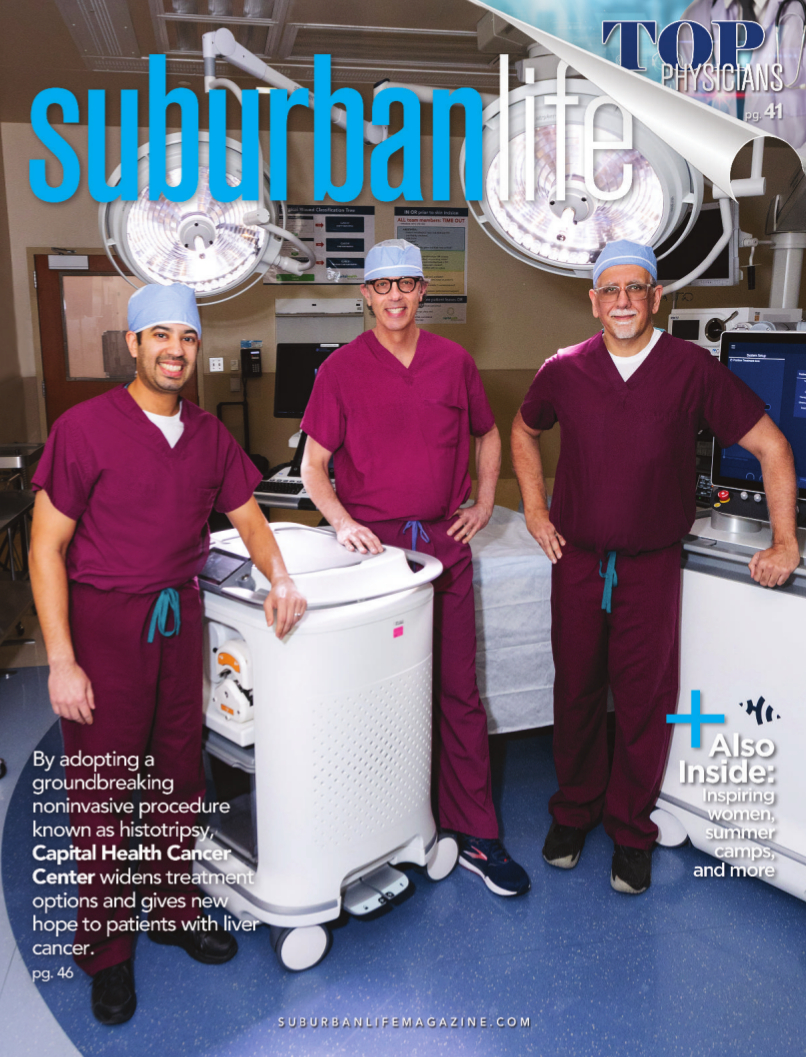
By adopting a groundbreaking noninvasive procedure known as histotripsy, Capital Health Cancer Center widens treatment options and gives new hope to patients with liver cancer.
Venturing into uncharted territory is nothing new to Cataldo Doria, M.D., Ph.D., M.B.A.
Over the past 30 years, including nearly eight as the medical director of Capital Health Cancer Center, Dr. Doria has pioneered multiple surgical advancements to treat malignant and benign diseases of the liver, pancreas, gallbladder, and bile ducts. He and his Capital Health colleagues are opening yet another new frontier with histotripsy, a noninvasive intervention—not a surgical one—for treating liver cancer.
Histotripsy is an FDA-approved form of ultrasound therapy that uses high-intensity soundwaves to destroy liver tumors while leaving surrounding tissue intact. Rather than replace surgery, radiation, or chemotherapy, histotripsy enhances those options. The technology can be used alongside ongoing treatments without interruption, and in some cases it can shrink tumors enough to make surgery possible later.
“The idea is to offer treatment to those who have no other hope, who may have exhausted other forms of treatment,” Dr. Doria explains. “The addition of histotripsy gives us an extra tool in the toolbox. Any time cancer is surgically resectable, surgery is the best option. But sometimes a patient may be too weak for surgery. That’s a classic example where histotripsy is ideal.
“Histotripsy is part of what we call liver-directed therapy, of which there are many forms,” he continues. “Some are done by a traditional oncologist, others are done by an interventional radiologist, and some are done by surgeons like me. The beauty of histotripsy at Capital Health is that it brings together the combined expertise of all three subspecialties.”
‘Nothing Quite Like It’
If Dr. Doria represents the seasoned surgical hand, Ajay Choudhri, M.D., represents the technological heartbeat behind the innovation. As chair and medical director of radiology at Capital Health and part of the leadership team that evaluates major medical investments, Dr. Choudhri carefully weighs the costs with the benefits of a new technology. He also must consider how a new technology would fit into the health system’s comprehensive care model.
If Dr. Doria represents the seasoned surgical hand, Ajay Choudhri, M.D., represents the technological heartbeat behind the innovation. As chair and medical director of radiology at Capital Health and part of the leadership team that evaluates major medical investments, Dr. Choudhri carefully weighs the costs with the benefits of a new technology. He also must consider how a new technology would fit into the health system’s comprehensive care model.
When histotripsy began appearing in medical journals, the technology caught his attention.
“There’s nothing quite like it,” he says. “It’s on the cutting edge of treatment, and only a couple of institutions have it. Each tool has its role, and I see histotripsy as augmentation rather than replacement. It widens the number of patients we can actually treat in our liver service, which is very active.”
Dr. Choudhri began his academic journey in the mid-1990s, “when medical devices were more primitive,” he recalls. Since joining Capital Health in 2003, he has enjoyed having a front seat to “the evolution of medicine.” As one example, he has witnessed the firsthand benefits of Capital Health’s steady adoption of robotic-assisted procedures. The cancer center has steadily honed its focus on robotic surgery since September 2018, when Dr. Doria became medical director.
“When I joined, we had one robot here, and it was completely underutilized,” Dr. Doria adds. “We have since expanded the number of robots we have, including the histotripsy robot. When you have talented people who are trained on the technology, robotic procedures tend to be more precise, provide for faster recovery, and result in less pain for patients with cancer.”
To his point, histotripsy patients go home the same day. For Dr. Doria, a surgeon who has spent a decades-long career mastering complex abdominal operations, the absence of a scalpel might seem almost counterintuitive. Yet he cannot contain his excitement about the technology’s promise.
“It’s a tool that will allow doctors like me to offer patients more years of life in good condition,” he says. “And it’s not just for liver tumors. I think, in the next five years, it will be used almost everywhere in the body. I really think it’s going to be the future.”
Complementary, Not Competing
At Capital Health, the path to histotripsy begins with careful deliberation. An interdisciplinary tumor board consisting of surgeons, interventional radiologists, radiation oncologists, and medical oncologists reviews the case of every patient with liver cancer. Together they study scans, debate options, and map out the safest and most effective path forward for each patient.
At Capital Health, the path to histotripsy begins with careful deliberation. An interdisciplinary tumor board consisting of surgeons, interventional radiologists, radiation oncologists, and medical oncologists reviews the case of every patient with liver cancer. Together they study scans, debate options, and map out the safest and most effective path forward for each patient.
Nikhil Thaker, M.D., M.H.A., M.B.A., describes this multi-pronged approach as “an incredible strength.” As Capital Health’s medical director of radiation oncology, Dr. Thaker works side by side with Drs. Doria and Choudhri during each treatment. “All three of us are in the OR at the same time,” he adds.
Understanding how histotripsy works only reinforces why teamwork matters.
During the procedure, the patient is placed under general anesthesia to control the patient’s breathing; the liver moves with every inhale and exhale. A robotic arm, which is positioned above a bath of degassed water, sends high-intensity soundwaves through the skin and into the tumor. The resulting “bubble cloud” liquefies and destroys cancerous tissue in the liver, leaving benign genetic material that the body slowly reabsorbs—no incision, no probe, no invasive instrument.
Such advanced technology has always fascinated Dr. Thaker, who grew up in a family of engineers. The loss of his grandmother to metastatic breast cancer ultimately steered him toward a career in medicine. Since joining Capital Health three years ago, he has become part of the health system’s leadership circle, and has enjoyed using artificial intelligence, advanced image guidance, and other cutting-edge tools to deliver more precise treatments.
“Surgery has excellent outcomes, but it’s also the most invasive option,” Dr. Thaker says. “I think we’re going to see a gradual change in terms of options for patients that may reduce the need for upfront surgery. Histotripsy is the latest example of that. As these tools continue to mature and evolve, I think we’ll see more and more less invasive treatments.
“That said, there’s limitations with every modality,” he continues. “With histotripsy, one is the depth of where the lesion is located. If we can’t see [a tumor] on ultrasound, maybe because it’s blocked by a rib, it may not be able to be treated with histotripsy, but it may be perfect for SBRT (stereotactic body radiation therapy). That’s why it’s so important to have multiple modalities; they’re complementary, not competing.”
Capital Health has used histotripsy to successfully treat its first raft of patients. After each treatment, patients have undergone CT imaging within 24 hours and again about a month later. Drs. Doria, Choudhri, and Thaker reviewed those scans together to gauge the therapy’s efficacy.
“So far all the patients are doing well,” Dr. Choudhri adds. “One of them went back to work the very next day. We’ve had a couple of cures—all disease resolved—and no complications.”
Histotripsy as a therapeutic treatment may soon go beyond the liver. Clinical trials are currently exploring the technology’s use in kidney and pancreatic cancers, and ongoing research is evaluating its use in treating disease in other parts of the body.
At Capital Health, histotripsy is remarkable not only for its ability to treat liver cancer, but also for its multidisciplinary approach. Having a hepato-pancreato-biliary surgeon, an interventional radiologist, and a radiation oncologist all working closely together represents a dramatic step forward—even for someone like Dr. Doria, who has spent his career breaking new ground.
“This is a tool that will allow doctors like me to offer [patients with liver cancer] more years of life in good condition,” he says. “I have had the good fortune of pioneering many different things in surgery and medicine, and I’m grateful to be able to continue doing that with Capital Health. Every time, it’s an incredible feeling.”
Capital Health Cancer Center
One Capital Way
Pennington, NJ 08534
(609) 537-6363
capitalhealthcancer.org
One Capital Way
Pennington, NJ 08534
(609) 537-6363
capitalhealthcancer.org
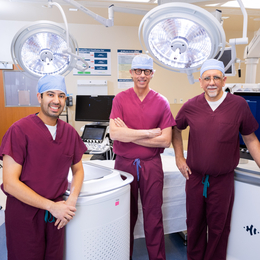
Photo by Alison Dunlap
Published (and copyrighted) in Suburban Life, March 2026.