

Into the Wild
Poet Grant Clauser explores humankind’s connections to—and collisions—with the natural world.
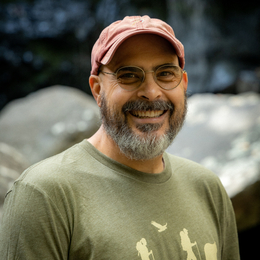
Grant Clauser came of age immersed in the wild spaces of Pennsylvania. The simple pleasures of walking in the woods, wading through streams, and turning over rocks in search of critters to admire shaped him not only as a person but also as a poet.
Clauser, who lives in Montgomery County, has authored several lauded books of poetry, including Reckless Constellations, Necessary Myths, and, most recently, Temporary Shelters. Many of his poems explore the connections between humankind and the natural world, and the resulting collisions.
“There are no solutions in my poetry, or most other people’s,” he says. “It doesn’t make me feel more at ease with the problems [of the world], but a refusal to examine them is, I think, a flaw.”
Clauser always has new poems in development. In addition, he’s currently editing a collection of poems authored by Brian Beatty, a friend and fellow MFA classmate from Bowling Green State University who passed away last year, for publication. A senior editor at The New York Times/Wirecutter, Clauser also teaches poetry and creative writing to students enrolled in Rosemont College’s MFA program.
“So many people who are not familiar with poetry probably feel intimidated by giving it a try as a reader,” he says. “Contemporary poetry is not the intimidating, scary stuff that their sophomore English teacher made them memorize. There’s a lot to be gained in losing yourself for an evening in a book of poetry.”
Q&A
Your poetry suggests you’re someone who spends a lot of time in the natural world. Why are the outdoors important to you?
Since I was a kid, most of the places that I’ve lived have been very rural adjacent, you could say, always within walking distance of a farmer’s field or some small woods. Those are the places I would always go to spend time either with friends or by myself, picking up rocks and seeing if there’s salamanders or snakes underneath them. I grew up close to lots of water so I was always fishing or just wading around, exploring things. Also, I was a Boy Scout for many years, and our troop was really into camping. … As an adult, I think I’m still a recovering Boy Scout.
Your poetry suggests you’re someone who spends a lot of time in the natural world. Why are the outdoors important to you?
Since I was a kid, most of the places that I’ve lived have been very rural adjacent, you could say, always within walking distance of a farmer’s field or some small woods. Those are the places I would always go to spend time either with friends or by myself, picking up rocks and seeing if there’s salamanders or snakes underneath them. I grew up close to lots of water so I was always fishing or just wading around, exploring things. Also, I was a Boy Scout for many years, and our troop was really into camping. … As an adult, I think I’m still a recovering Boy Scout.
Part of it is turning down the constant buzz that the world is always throwing, especially now and over the last 20 years. When you can get away from that, your gaze goes farther than just the laptop in front of you. … I like to say, especially to some of the classes I teach, is that artists—all kinds of artists—are people who spend more time thinking about their lives in a perspective way than I think non-artists do. Getting outside of the static-buzz environment, I think, helps facilitate that.
When and why did you first start writing poetry?
I started getting into poetry in my early high school years, or maybe middle school. Like a lot of kids, the first poet I was enthralled with was Edgar Allan Poe. Someone gave me his collected works for a birthday, and I just loved the music of it. I memorized The Raven, and I’ve got all kinds of other Poe lines in my head. … Then in college I met other people who weren’t ashamed to say that they wrote poetry. I just kept following that path.
I started getting into poetry in my early high school years, or maybe middle school. Like a lot of kids, the first poet I was enthralled with was Edgar Allan Poe. Someone gave me his collected works for a birthday, and I just loved the music of it. I memorized The Raven, and I’ve got all kinds of other Poe lines in my head. … Then in college I met other people who weren’t ashamed to say that they wrote poetry. I just kept following that path.
Many of your poems talk about the horrors humankind has visited upon trees and land and rivers and the creatures that live in those places. Is it difficult to write about painful things?
It’s hard to look at the best things in life without contrast. When I’m in a beautiful place, having a moment sitting on a mossy rock by a stream, I know that’s a blessing. There’s also an opposite side of that; a lot of the world isn’t that beautiful, and we’re the reason why a lot of the world isn’t that beautiful. That’s often what draws the poetry out: not being satisfied with the simplicity of a good experience, but also poking and prying at it and seeing what else is there around it.
It’s hard to look at the best things in life without contrast. When I’m in a beautiful place, having a moment sitting on a mossy rock by a stream, I know that’s a blessing. There’s also an opposite side of that; a lot of the world isn’t that beautiful, and we’re the reason why a lot of the world isn’t that beautiful. That’s often what draws the poetry out: not being satisfied with the simplicity of a good experience, but also poking and prying at it and seeing what else is there around it.
You teach poetry and creative writing at Rosemont College. Why did you want to teach?
I love it so much because for three hours a week I get to talk about something I love. … I share a lot of new poets. We talk about techniques and what makes this poem function differently than that poem, but mostly I want to make sure that that appreciation of the art form and their place in it just stays with them and becomes part of their lives. Not everyone graduating will stick with it or achieve the goals they had when they signed up, but if they continue having that art being a vital part of who they are, then even that’s a success.
I love it so much because for three hours a week I get to talk about something I love. … I share a lot of new poets. We talk about techniques and what makes this poem function differently than that poem, but mostly I want to make sure that that appreciation of the art form and their place in it just stays with them and becomes part of their lives. Not everyone graduating will stick with it or achieve the goals they had when they signed up, but if they continue having that art being a vital part of who they are, then even that’s a success.
Photo by Alex Pope
Published (and copyrighted) in Suburban Life, March 2026.