
Closing the Gap
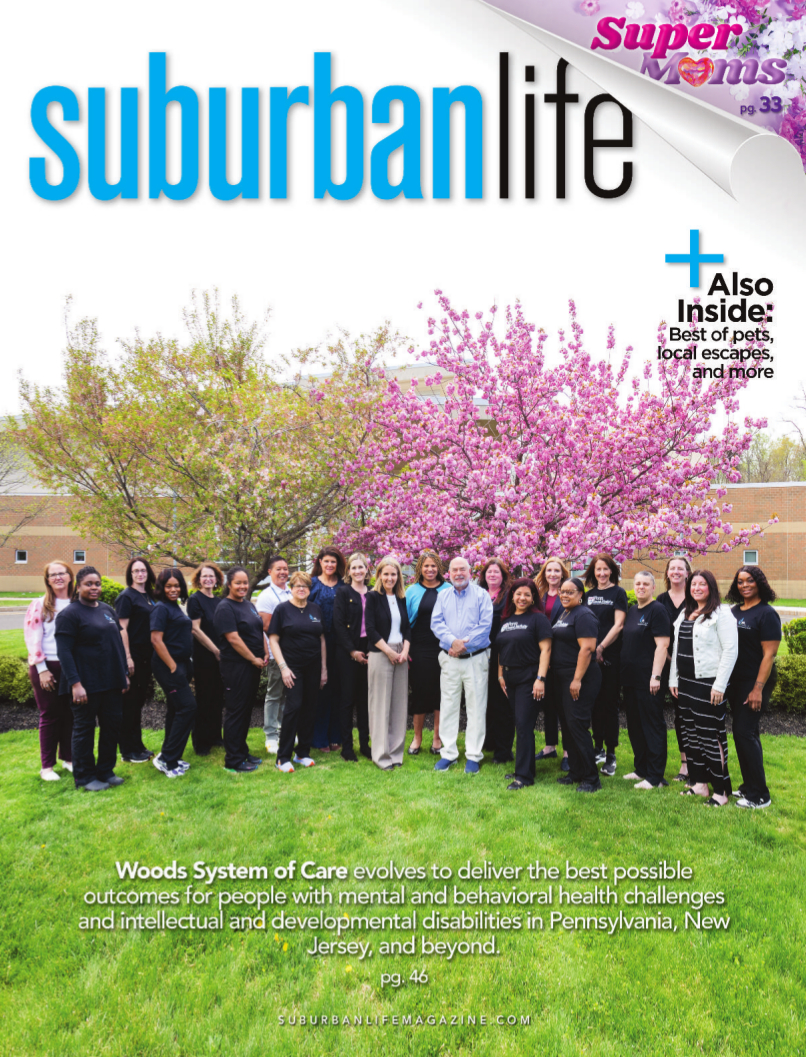
Woods System of Care evolves to deliver the best possible outcomes for people with mental and behavioral health challenges and intellectual and developmental disabilities in Pennsylvania, New Jersey, and beyond.
In 1992, when Tine Hansen-Turton, MGA, JD, FCPP, FAAN, moved from her native Denmark to Philadelphia, she noticed a world of difference between how each country cared for its people. Whereas Denmark designed its healthcare model to ensure that no Dane “falls through the cracks,” America’s porous system meant some citizens, particularly the most vulnerable, sometimes got overlooked or forgotten.
Now, as president and CEO of Woods System of Care, Hansen-Turton stands at the helm of a dynamic nonprofit organization devoted to delivering lifecycle care for individuals with mental and behavioral health needs, intellectual disabilities, autism, acquired brain injuries, and other challenges. She leads a team of skilled helpers and doers, all driven by a common goal: to address all of a person’s needs and strive for the best possible health and behavioral outcomes throughout their lifespan.
Hansen-Turton describes herself as “a systems person who is mission-driven and likes to solve problems.” When she came to what began as Woods Services in October 2016, she brought with her not only her formative experiences from Scandinavia, but also years of experience in executive-level leadership in the health and human services sector. Up until that point, Woods had focused primarily on residential services, education, and workforce development for neurodiverse individuals in Pennsylvania and New Jersey; healthcare represented a small part of its overall mission.
“We were just toe-dipping into it,” Hansen-Turton recalls. “That was the opportunity to address the gaps for this population through accessible care and providers who are trained in neurodiverse care. When I was interviewing for the Woods job, I was shocked that even somebody like me, who has served all kinds of vulnerable populations [throughout my career], did not realize there was a population that was so missed in the healthcare system. That’s the core of what has driven our approach. It’s whole-person care, it’s lifecycle care, and it’s population health.”
Game-Changing Efforts
To offer true whole-person lifecycle care, Woods had to expand its services. Hansen-Turton saw the affiliation model as the best way to harness the expertise of individual organizations and increase access to care. Woods Services is now one of the 14 affiliated organizations that make up the broader Woods System of Care. Together, these providers serve approximately 40,000 people in Pennsylvania, including all five counties comprising the Philadelphia area, across New Jersey, and in Delaware.
To offer true whole-person lifecycle care, Woods had to expand its services. Hansen-Turton saw the affiliation model as the best way to harness the expertise of individual organizations and increase access to care. Woods Services is now one of the 14 affiliated organizations that make up the broader Woods System of Care. Together, these providers serve approximately 40,000 people in Pennsylvania, including all five counties comprising the Philadelphia area, across New Jersey, and in Delaware.
Woods System of Care treats clients of all ages, starting at 12 months for autism assessment and through the end of life. A gentleman named Harold had been Woods’ oldest client until his recent death at the age of 95, according to Hansen-Turton. As far as she knows, Woods is unique in the United States in terms of its ability to provide the continuum of care delivered by healthcare professionals—physicians, nurses, nurse practitioners, and allied health professionals—who specialize in caring for individuals with complex needs. The system does that with what they call a no-wrong-door approach.
“Anybody stepping into any of our organizations as part of the system can get lifecycle care, all the way to the end of life,” she adds. “That’s the biggest value proposition for any family member who comes into our service area.”
While Woods System of Care’s providers span three states, it all began in Langhorne, where Woods Services has been operating for more than a century. The property is the hub for Woods Integrated Healthcare, which delivers integrated primary care and specialty medicine such as neurology, optometry, and women’s health, as well as behavioral health and dental care, among other services. The property will soon include an accredited micro-hospital focused on treating individuals with intellectual disabilities and autism; the 16-bed facility is expected to open its doors by the end of 2027.
“Woods’ integrated care model is person- and family-centered, and grounded in integrated, interdisciplinary care,” says Sailaja Musunuri, M.D., FCPP, Woods System of Care’s chief medical and clinical officer, executive vice president of integrative medicine, and executive director of the Mollie Woods Hare Global Center of Excellence. She explains that providers across disciplines work collaboratively to address all of a client’s needs.
“Our model brings together physical health, behavioral health, psychiatry, dental, and specialty services in one coordinated system,” she adds. “Our integrated care teams actively drive system change and advocate for policy improvements to better serve individuals with intellectual disabilities and autism.”
The Mollie Woods Hare Global Center of Excellence, established by Dr. Musunuri, is a hub for research, training, and international collaboration that aims to improve the care and outcomes for individuals with intellectual disabilities, autism, and related conditions—in Pennsylvania, New Jersey, and around the world.
While every care provider is extensively trained in meeting the specific needs of individuals with complex needs, Woods Integrated Healthcare also serves the broader community.
“It’s important to note that we now serve everybody, not just our own [residential] patients or clients,” Hansen-Turton says. “Over the past four years, we have become open to the community, and I think it has been a game-changer in driving partnerships with hospitals and other settings.”
Such partnerships have extended Woods’ reach far beyond the borders of Bucks County. In 2025, for example, Woods linked arms with RWJBarnabas Health to create the Woods Primary and Behavioral Health Center at Hamilton in New Jersey’s Hamilton Township. The center offers the full range of primary care and behavioral health services to families from surrounding communities. It’s the first such medical center in the area to also offer specialized care for individuals with complex needs.
While the details are not yet available for public consumption, Woods is currently in talks to recreate the model with other health systems in Pennsylvania and New Jersey, and even into contiguous states.
Leading the Way
As part of its mission, Woods trains and educates future generations of healthcare providers. At present, the organization has contracts and affiliated agreements with approximately two dozen hospitals and universities to equip their physicians, nurses, and students with the specialized knowledge needed to treat individuals with intellectual, developmental, and behavioral challenges.
As part of its mission, Woods trains and educates future generations of healthcare providers. At present, the organization has contracts and affiliated agreements with approximately two dozen hospitals and universities to equip their physicians, nurses, and students with the specialized knowledge needed to treat individuals with intellectual, developmental, and behavioral challenges.
“For us to address the need for the 7 million people in the country who have some sort of disability or neurodiverse challenge, we need to make sure we have a trained workforce,” Hansen-Turton says. “Our people are very compassionate and want to help the people we serve. We have been educating them about what healthcare can do, and in some cases training them to do new jobs. We have also brought in new team members who have very strong, very specific skill sets.”
Woods has also been an active influencer of government policy. Amid a complex and mercurial regulatory environment, the organization makes sure its constituents’ voices are heard, according to Kristen Farry, executive vice president of policy and strategy for Woods.
“I think we have led the way in a lot of those dialogues and conversations, where now we are seeing others follow our prioritization of advocacy, engaging with contract lobbyists, or hiring people on staff to manage government relations,” Farry says. “We’re having a dialogue with the legislators and policymakers who make those decisions. … If we see a problem, we immediately get to work thinking about how we can solve it and [determine] what success looks like.”
In the process, Woods has not only streamlined care for its constituents but also helped to siphon significant cost out of the U.S. healthcare system.
“We’re showing our colleagues that absolutely you can change rules, you can change regulations, and you can propose new models of care,” Hansen-Turton says. “It’s not just about providing care; you also have to show value to the healthcare system. There are going to be cuts in the system, so organizations like ours have to continue thinking outside the box. If we’re providing services in the community, we can avoid unnecessary ER visits or hospitalizations.”
Woods System of Care has undergone a dramatic transformation over the past 113 years, including the past decade under Hansen-Turton’s leadership. Woods’ evolution will continue, as the organization expands its footprint, explores new models of care, and otherwise creates new ways to better serve members of a growing community.
“What makes me proudest is every time we hear someone is able to do something new or have an experience that changes their life,” Hansen-Turton says. “When you go to one of the nine Woods Schools, you hear the stories of kids who came to us with all these challenges they have had to overcome, and you see what they are able to do now.”
Through its education, workforce development, residential services, integrated healthcare, behavioral health, and social supports, Woods helps individuals achieve their highest potential and independence.
“I think that’s our why,” Hansen-Turton concludes, “and that’s what keeps us going.”
For more information about Woods System of Care and its scope of services in the Philadelphia area and in New Jersey, visit www.woods.org. For more information about Woods Healthcare, visit woodshealthcare.org or call (215) 750-4004.
Photo by Alison Dunlap
Published (and copyrighted) in Suburban Life, April 2026.