

Spreading the Word
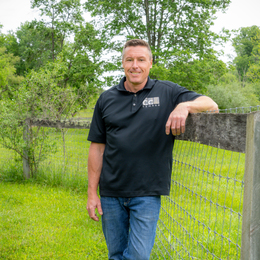
For local homeowners vetting contractors to manage bamboo and other nonnative plants, Chester County Bamboo founder John Kohler has an important message: Choose wisely.
John Kohler has a deep appreciation for bamboo, a fondness bordering on affection. He respects the plant for its beauty and rapid growth, its carbon-negative life cycle, and its effectiveness as both a privacy barrier and form of erosion control. In the same breath, he has spent the past 17 years learning how to remove, manage, and bend bamboo to his—and his clients’—will.
Kohler, the founder and president of Chester County Bamboo LLC, has earned his reputation as a trusted resource for managing bamboo’s relationship with landscapes throughout the Philadelphia area. When he started Chester County Bamboo in the early 2000s, most of his jobs were of the installation sort. The rise of township ordinances to restrict, if not outlaw, the use of bamboo has reduced new plantings to less than 5 percent of his business.
Those ordinances have come in spite of bamboo’s many positive attributes and the fact that some species of bamboo—the largest member of the grass family—are considered endemic to the United States. In Kohler’s mind, bamboo just needs to be tamed every now and then, much like any other natural resource. Whether homeowners want to add or remove the plant, he’s eager to help.
“After 17 years, I have a proven track record,” he says. “I have done close to 1,000 jobs in the area, installing miles of root barrier, from Delaware County to Bucks County and down into the state of Delaware. Our contracts include a full guarantee, so if for some reason the bamboo comes back, we’ll return at no additional cost and take care of it. It’s also important to note that we don’t use any chemicals in the initial or any potential follow-up treatment.”
Kohler feels compelled to spread the word, because he has seen an uptick in the number of companies that claim to specialize in bamboo management, many of whom advertise aggressively—and, he believes, dishonestly—online. Many of these outfits have roots in other sectors of the home-improvement industry, he suggests, but see managing bamboo as an “easy” way to diversify their business in an economic downturn.
Kohler wants people to understand this: The work he and his team perform day in and day out is anything but easy. Furthermore, anyone who doesn’t understand the plant because they have little to no expertise working with it is likely to fail. As a result, any homeowner who hires one of these untested “specialists” will likely be left with an unsolved problem.
“Anyone can look like an expert online,” he says. “There are no arborist-type certifications for bamboo, so it all comes down to experience. I always say the devil is in the details, and this is a details business. If you hire someone who doesn’t know what they’re doing and they don’t offer a written guarantee, all you have is a failed job.”
Kohler’s fascination with bamboo began when he needed a privacy screen for a home in Malvern. A six-foot span near an in-ground pool could not accommodate evergreens or other slow-growing trees; bamboo fit the bill perfectly. He has had a passion for it ever since.
Kohler may be the widest-known bamboo expert on the East Coast. He serves on the board of directors for the American Bamboo Society. He has given expert witness testimony in legal disputes as far as away as Virgina and Florida. Also, when Pennsylvania was considering classifying bamboo as a noxious plant statewide, he made his case to the Department of Agriculture, stating that without the proper certifications, the classification would likely spur the creation of untested “ambulance chasers” looking to cash in; ultimately the department agreed with him and the vote was scuttled.
Kohler has created his own highly effective barrier system. His proprietary system includes a special bracket to secure the seam between two pieces of barrier, thereby keeping it secure when drilling holes for the bolt placement. He has obtained multiple patents for his system.
“I’m very passionate about this business,” he adds. “I’m also passionate about the ethics behind the business; I’m not just here to make a sale. I have learned this business by doing, in part by fixing my own wrongs on early jobs. That’s why I still like to be on every job, because I enjoy the work and I want clients to get exactly what they’re paying for.”
His interest in bamboo has since extended to other nonnative plants, some of which are far more invasive and destructive than bamboo. After moving to a 28-acre farm near Marsh Creek State Park, he was astounded by what he discovered when exploring the property: nonnative plants such as multiflora rose, Japanese knotweed, skunk cabbage, and Russian olive. He’s not yet an expert in these species, but he’s a quick study. For example, he has researched the best times of year to prune and remove these species so they don’t disperse seeds.
Besides his own property, he has begun taking notes elsewhere.
“I’m watching a lot of places be overcome by invasive species,” he says. “Some of Delaware County’s streamways are being overtaken by knotweed. In Radnor a few years ago, they cut down nonnative phragmites (tall wetland grass) and caused it to spread. In Tredyffrin, someone planted some nonnative ornamental grasses that spread by seed, and it’s just taking over. Multiflora rose has no environmental benefit, but it’s choking off native plants and taking more land.
“I’ve also seen some of these species spreading along the [Pennsylvania] Turnpike, and once something like that happens, they’re almost unstoppable with the traffic going in all directions,” he continues. “Other people aren’t aware of what’s happening, and the townships probably aren’t noticing either. The funny thing is that bamboo can be controlled, but these other species are almost uncontrollable. Mother Nature is not always your friend.”
Chester County Bamboo LLC
(610) 888-4900 | john@ccbamboo.com
ccbamboo.com
(610) 888-4900 | john@ccbamboo.com
ccbamboo.com
Photo by Jody Robinson
Published (and copyrighted) in Suburban Life, August 2026.