
Swing of the Ax
In his historical fantasy Valhalla Burning, novelist Michael Pogach tells a story about the metamorphic power of family, grief, and vengeance.
Michael Pogach has been a storyteller for as long as he can remember. He traces his love of stories to the culture of his youth, including action figures and games such as The Legend of Zelda. His parents deserve some credit, too. As a child, when he asked for toys during shopping trips with his family, his parents—his mother in particular—had a simple rule: “Yes, to a book. You can always get a book.”
Their encouragement paid off. Pogach, a Quakertown resident who teaches literature and creative writing at Northampton Community College in Bethlehem, has had many of his stories picked up by publishers. His latest novel, Valhalla Burning from Diversion Books, will be released in July. A work of historical fantasy, Valhalla Burning is a richly written (and occasionally bloody) tale about a Northman named Rúnr who undertakes a transformative journey after the death of his daughter.
The Doylestown Bookshop will host a launch event for Valhalla Burning on Thursday, July 23.
Q&A
To boil it down, Valhalla Burning is a dark story about family and grief and vengeance—and Vikings. What compelled you to write this story?
When I finish writing a book, I have a massive existential crisis where I don’t know if I’m ever going to have a story again to tell. I was on sabbatical from my teaching job in the fall of 2020. … Right about that time, I was playing Assassin’s Creed Valhalla. Because I have little kids, I can’t play video games like I used to. It took me about a year and a half to [finish] Assassin’s Creed Valhalla. Somewhere in there, I just decided: Hell, I’m going to write a Viking book. That was kind of the start of it. I had just read Heart-Shaped Box by Joe Hill, and I decided I wanted to do a Viking ghost story. … I sat down and wrote 30,000 words and then put it away, and then in the spring I came back to it. Over the next year or so it morphed away from being this ghost story into what it is now, which is what I pitched as like John Wick but with Vikings.
To boil it down, Valhalla Burning is a dark story about family and grief and vengeance—and Vikings. What compelled you to write this story?
When I finish writing a book, I have a massive existential crisis where I don’t know if I’m ever going to have a story again to tell. I was on sabbatical from my teaching job in the fall of 2020. … Right about that time, I was playing Assassin’s Creed Valhalla. Because I have little kids, I can’t play video games like I used to. It took me about a year and a half to [finish] Assassin’s Creed Valhalla. Somewhere in there, I just decided: Hell, I’m going to write a Viking book. That was kind of the start of it. I had just read Heart-Shaped Box by Joe Hill, and I decided I wanted to do a Viking ghost story. … I sat down and wrote 30,000 words and then put it away, and then in the spring I came back to it. Over the next year or so it morphed away from being this ghost story into what it is now, which is what I pitched as like John Wick but with Vikings.
The story begins quickly, with an event that sets the rest of the story in motion. I don’t want to give away too much, but tell me about how you got into the mindset of your main character, who goes on a long, hard journey, we’ll say.
Rúnr [the novel’s protagonist] has lost his four-year-old daughter, and this is obviously traumatic for him, and he’s trying to come to terms with that loss: what it does to his family, to his status in his village, what it means for him as a Northman, as a man; the book definitely has a lot to do with what it means to be a human versus a man versus a woman versus what society says about what you feel, who you really are. He starts to learn, once he gets out of his insular home, what the world really offers and what he’s capable of in terms of growth and healing, but also in terms of rage and vengeance and things like that.
Rúnr [the novel’s protagonist] has lost his four-year-old daughter, and this is obviously traumatic for him, and he’s trying to come to terms with that loss: what it does to his family, to his status in his village, what it means for him as a Northman, as a man; the book definitely has a lot to do with what it means to be a human versus a man versus a woman versus what society says about what you feel, who you really are. He starts to learn, once he gets out of his insular home, what the world really offers and what he’s capable of in terms of growth and healing, but also in terms of rage and vengeance and things like that.
The story seems rooted in actual history, but it has supernatural underpinnings, too. Based on your research, what role did the supernatural—connections with gods, prophets, the afterlife—play in Vikings’ beliefs, their lives, and the way they saw the world?
In all of my books, I like to play with mythology and folklore. One thing I like to tell my students, when we talk about things like Norse mythology, we don’t talk about what the Scandinavians of the 9th and 10th centuries believed, because that implies the idea that they understood that it was this thing they were choosing to involve themselves in. It’s the same approach we take when we talk about witchcraft in the later Middle Ages. [People back then] didn’t believe in devils and witches; they knew they were real.
In all of my books, I like to play with mythology and folklore. One thing I like to tell my students, when we talk about things like Norse mythology, we don’t talk about what the Scandinavians of the 9th and 10th centuries believed, because that implies the idea that they understood that it was this thing they were choosing to involve themselves in. It’s the same approach we take when we talk about witchcraft in the later Middle Ages. [People back then] didn’t believe in devils and witches; they knew they were real.
Mythology is about explaining the things we don’t necessarily have the tools to explain some other way. Norse mythology is not just Loki doing his thing and Thor swinging a hammer; it’s also very granular, [and] very involved in the earth and the water and the sea and the fjords, the mountains. It’s about everyday life. The gods are a part of the characters’ lives, the mystical nature of life, and death and birth and everything else. Then there’s hints of straight-up monsters and other fun stuff as well. … I chose which aspects of Norse culture to focus on to give the feeling of legitimacy and honest history.
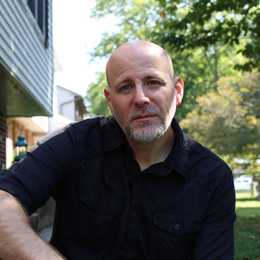
Photo courtesy of Michael Pogach
Published (and copyrighted) in Suburban Life, May 2026.