
The Road Less Traveled
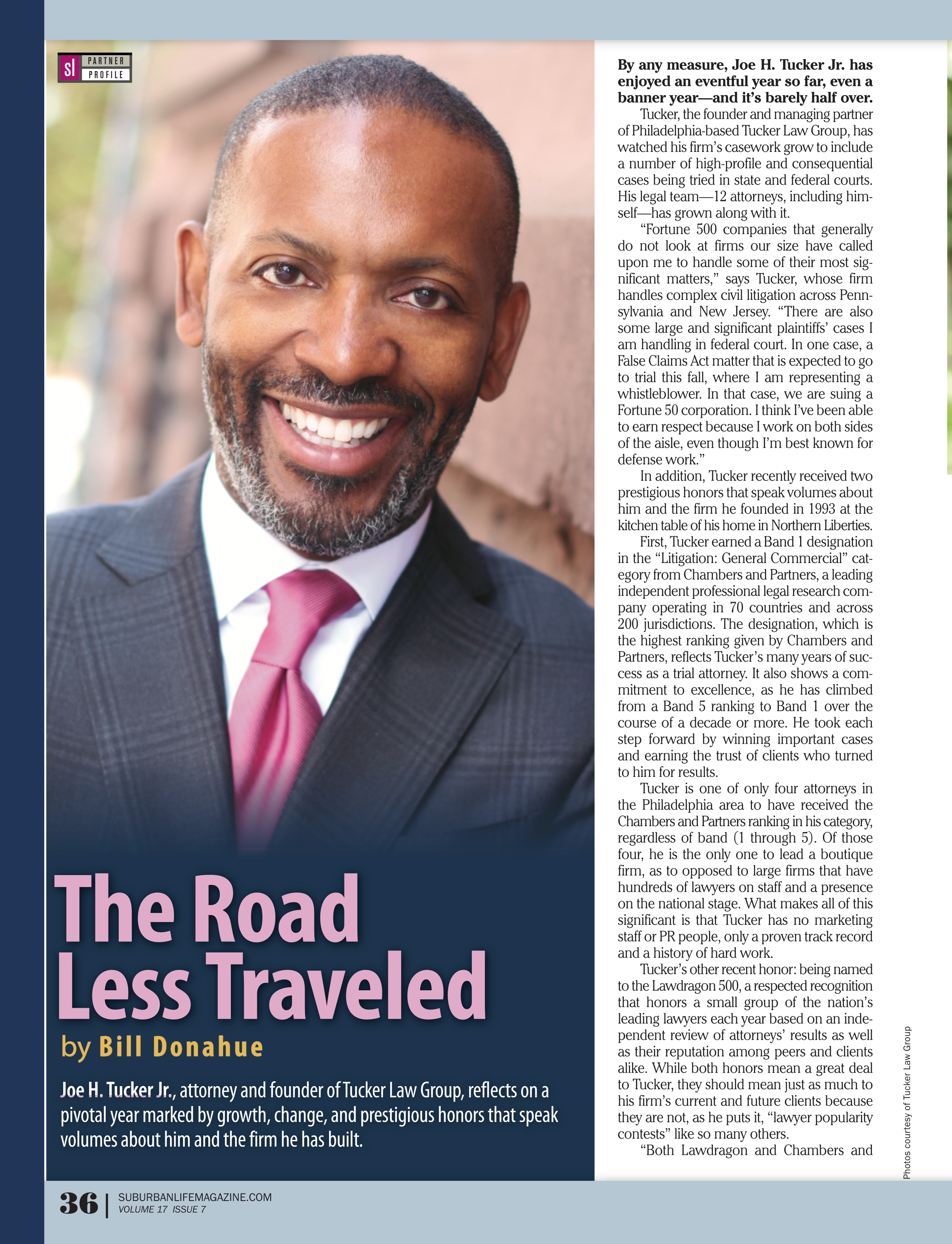
Joe H. Tucker Jr., attorney and founder of Tucker Law Group, reflects on a pivotal year marked by growth, change, and prestigious honors that speak volumes about him and the firm he has built.
By any measure, Joe H. Tucker Jr. has enjoyed an eventful year so far, even a banner year—and it’s barely half over.
Tucker, the founder and managing partner of Philadelphia-based Tucker Law Group, has watched his firm’s casework grow to include a number of high-profile and consequential cases being tried in state and federal courts. His legal team—12 attorneys, including himself—has grown along with it.
“Fortune 500 companies that generally do not look at firms our size have called upon me to handle some of their most significant matters,” says Tucker, whose firm handles complex civil litigation across Pennsylvania and New Jersey. “There are also some large and significant plaintiffs’ cases I am handling in federal court. In one case, a False Claims Act matter that is expected to go to trial this fall, where I am representing a whistleblower. In that case, we are suing a Fortune 50 corporation. I think I’ve been able to earn respect because I work on both sides of the aisle, even though I’m best known for defense work.”
In addition, Tucker recently received two prestigious honors that speak volumes about him and the firm he founded in 1993 at the kitchen table of his home in Northern Liberties.
First, Tucker earned a Band 1 designation in the “Litigation: General Commercial” category from Chambers and Partners, a leading independent professional legal research company operating in 70 countries and across 200 jurisdictions. The designation, which is the highest ranking given by Chambers and Partners, reflects Tucker’s many years of success as a trial attorney. It also shows a commitment to excellence, as he has climbed from a Band 5 ranking to Band 1 over the course of a decade or more. He took each step forward by winning important cases and earning the trust of clients who turned to him for results.
Tucker is one of only four attorneys in the Philadelphia area to have received the Chambers and Partners ranking in his category, regardless of band (1 through 5). Of those four, he is the only one to lead a boutique firm, as to opposed to large firms that have hundreds of lawyers on staff and a presence on the national stage. What makes all of this significant is that Tucker has no marketing staff or PR people, only a proven track record and a history of hard work.
Tucker’s other recent honor: being named to the Lawdragon 500, a respected recognition that honors a small group of the nation’s leading lawyers each year, based on an independent review of attorneys’ results as well as their reputation among peers and clients alike. While both honors mean a great deal to Tucker, they should mean just as much to his firm’s current and future clients because, as he puts it, they are not “lawyer popularity contests” like so many others.
“Both Lawdragon and Chambers and Partners reach out anonymously to clients and other lawyers to talk to discuss the type of lawyer I am, what I do for them, and why they call upon me,” he explains. “To this day I don’t know which of my clients they’ve spoken with, but it’s an honor to hear the kinds of things those clients have said about me.”
Tucker achieved yet another milestone earlier this year. On April 11, he completed his term as president of the International Academy of Trial Lawyers, an invitation-only organization limited to 500 trial lawyers from the United States and 150 fellows from 30 different countries, all devoted to the Rule of Law. His time at the helm of the organization was, in a word, transformative.
“During my presidency, we traveled to Vancouver to Namibia, South Africa, Botswana, Zimbabwe, and the Seychelles, ending up in Charleston, South Carolina, for our big annual meeting,” he says. “I was the academy’s first Black president, and I wanted to expose members of the organization to aspects of society that they probably haven’t been exposed to.”
At the academy’s meeting in Vancouver, for example, members of an Indigenous tribe gave an opening prayer. In southern Africa, academy members discussed the weight and consequence of their surroundings—“the place where life began,” Tucker says. In South Carolina, discussion centered on the complex history of Charleston, whose Gadsden Wharf was once the epicenter of the slave trade in the United States. The International African American Museum, which now sits at that location, was the site of a special dinner for the academy. A personal highlight of Tucker’s was a “fireside chat” with U.S. Rep. James Clyburn, who in 1992 became the state’s first Black congressman in nearly a century when he was elected to represent South Carolina’s 6th Congressional District.
As the academy’s president, “Everything we did had an excellent response and was very well received by the members,” Tucker says. “Also, during my presidency, I established a podcast (The Rule of Law: The Academy Speaks), and I was active active in speaking out where we saw attacks on the Rule of Law and where we saw other injustices. Notably, the Board of the Academy unanimously voted for the abolishment of the death penalty as part of a push I made.”
Injustice, after all, is what compelled Tucker to become an attorney in the first place. As a young man coming of age in North Philadelphia, he developed a heightened awareness of the power behind the law.
“The injustices were right there in my face,” he recalls. “From housing discrimination to job discrimination for me and my family, you could not grow up how and where I grew up and not be keenly aware of how unjust society was and is to Black people.”
As Tucker reflects on how far he has come, he feels a sense of immense gratitude. He likes to tell a story involving his interview for admission to the New York State Bar Association in 2019. He recalls the young woman who was leading the interview telling him, “I see you’re living your life’s dream.” He didn’t know what she was referring to until she showed him his applications to Howard University and Temple University Beasley School of Law. In his undergraduate application, he explained his desire to be a successful—in his words from 1979—“Afro-American business owner.” In his law school application, he declared that he wanted to work at a large law firm before starting his own firm as a trial lawyer.
He has accomplished all of the above and then some, not that any of it has been easy. He credits “a village that uplifts and affirms me,” which includes a support network of his wife, family, and close friends, as well as a legal team that continually keeps him learning and growing. He also prioritizes mostly solitary pursuits such as cycling and fly fishing, both of which help quiet his mind. In late June, he was preparing to embark on a 10-day trip to Alaska, where he expected to cast for salmon and rainbow trout.
Despite his many accomplishments, Tucker remains focused and modest. He also knows he still has more work to do.
“Given the road I have traveled and where I started, I have to be satisfied with where I am,” he says. “Do I want more? Yes. Do I envy other people? No. I am perfectly content with what I have done. … At this point, I want to make it to the finish line without tripping. Where the finish line is, I’m not sure, but I know I want to get there without disrupting all those things I’ve put countless hours into building throughout my career.”
At the end of the day, he adds, “I want to give all to everything I do.”
Tucker Law Group
100 N. 20th Street, Suite 301
Philadelphia, PA 19103
Office: (215) 875-0609 | Direct: (215) 982-2268
www.tlgattorneys.com
jtucker@tlgattorneys.com
100 N. 20th Street, Suite 301
Philadelphia, PA 19103
Office: (215) 875-0609 | Direct: (215) 982-2268
www.tlgattorneys.com
jtucker@tlgattorneys.com
Photo courtesy of Tucker Law Group
Published (and copyrighted) in Suburban Life, June 2026.