
The Best Get Better
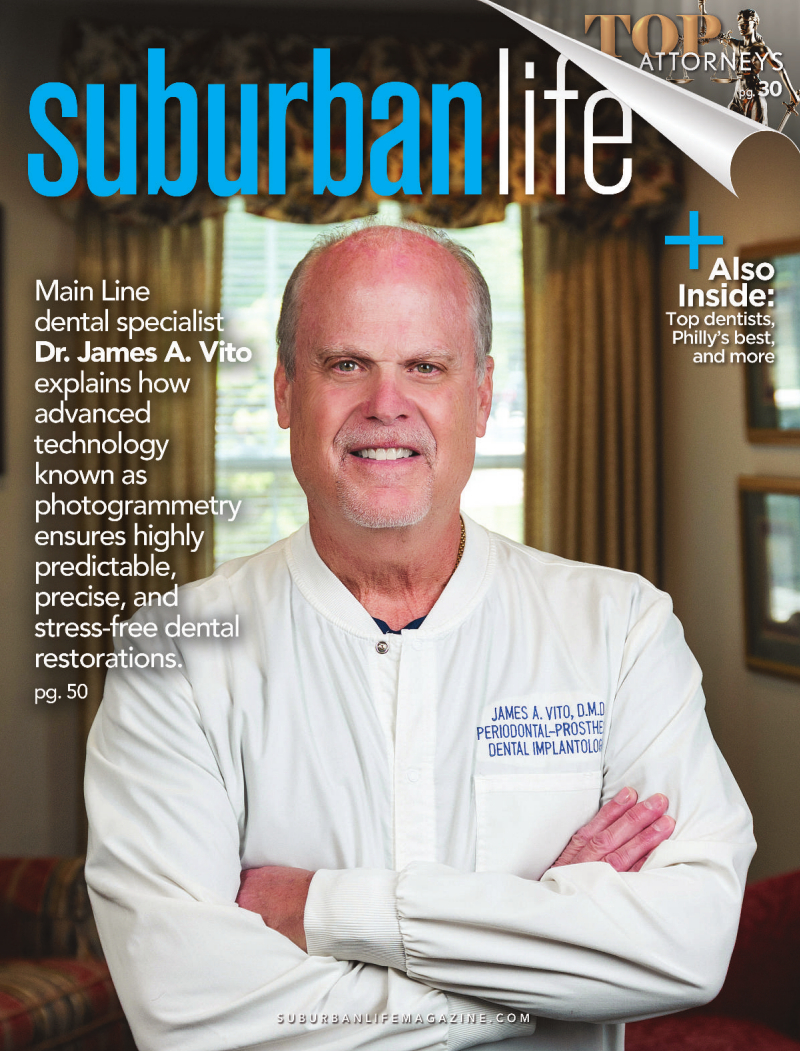
Main Line dental specialist Dr. James A. Vito utilizes advanced technology known as photogrammetry to ensure highly predictable, precise, and stress-free dental restorations.
A few years ago, I was interviewed about some of the advancements that were being made in modern dentistry. At that time there were a series of advancements in digital dentistry that improved the caliber and predictability of dentistry.
Those developments had to do primarily with dental X-rays. We had digital X-rays and 3D X-rays to better diagnose dental issues, to analyze specific situations in 3D, if necessary, and to plan the surgical placement of dental implants before we even pick up a scalpel.
Digital dentistry improves X-ray image quality in part by allowing the enlargement of the image. Now, given the recent advancements in artificial intelligence, incorporating AI into digital radiography helps us verify and identify more decay, endodontic issues, and pathology before they reach a level that could be considered an emergency.
Instead of messy impression materials, we now utilize digital dentistry for the restoration of teeth and dental implants. With new digital scanners, we can take better and higher-quality dental impressions, resulting in dental restorations that fit better and, consequently, last longer.
One of my passions since I started dentistry has been dental implant surgery and dental implant restorations. Both come with their share of challenges, but digital dentistry has made the surgical placement of dental implants better overall—more consistent, more predictable, and more efficient.
This leads us to one of the more recent advances in digital dentistry: photogrammetry. Photogrammetry is technology that combines photography, mathematics, and computer science to generate highly accurate 3D models from 2D images. It is used to capture the precise positions and angulations of dental implants in three dimensions.
Unlike traditional impressions or intraoral scans alone, photogrammetry focuses on one thing with extreme precision: where the implants actually are in space. According to a recent study, photogrammetry produced digital dental models with a higher degree of precision, accuracy, and trueness than any other impression technique.
A passive fit of the resulting restoration is very important for a long-lasting result. The longevity of an implant restoration depends on the stress it places on both the implant components and the underlying bone; it is vital to have minimal stress and strain placed on both. Any inaccuracy results in an improper fit that stresses the restoration, resulting in breakage and strain to the underlying bone. In turn, the dental implant can fail prematurely.
While traditional dental impressions can leave up to 100 microns of discrepancy between implants, photogrammetry systems can reduce this discrepancy to just five microns. In fact, a systematic review and meta-analysis found that stereophotogrammetry demonstrated higher precision than intraoral scanning for complete-arch implant impressions.
This level of accuracy ensures a passive-fit prosthesis that minimizes stress and strain on the supporting implants. It is precise enough that some manufacturers guarantee the fit of substructures fabricated from photogrammetry scans. As a result, the patient receives a highly predictable, stress-free final restoration achieved with fewer appointments and less time for each appointment.
Our office recently invested in this new photogrammetry technology. I can say that it has been a game-changer in terms of patient comfort and more efficient and accurate impressions, as well as more predictable long-term final restorations.
In conclusion, dentistry has caught up with most of the issues dentistry presents to us today. By understanding and utilizing the most current technology, we can provide the best dental care possible, and a better overall experience, for our patients.
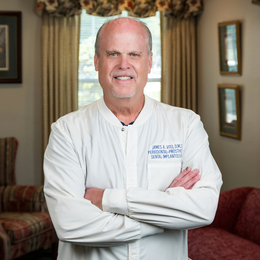
Dr. Vito has been providing general and advanced adult restorative dentistry, as well as dental implant surgery and restoration, since 1987. He can be reached at www.jamesvito.com or (610) 971-2590. His office is located at 523 East Lancaster Ave. in Wayne, PA 19087.
Photo by Jeff Anderson
Published (and copyrighted) in Suburban Life, June 2026.