
Second Harvest
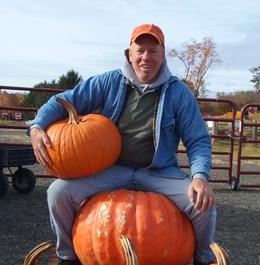
Paul Hellerick, co-owner of Hellerick’s Adventure Farm, talks reinvention and agritourism.
Paul Hellerick made fond memories during summer trips to “the family farm” in Doylestown. The property, located on Easton Road, right on the edge of Plumsteadville, looks vastly different than the one he remembers from childhood.
Now known as Hellerick’s Adventure Farm, the property houses dozens of family-friendly activities rooted in the rich soil of agritourism. A very partial list of things to do on site: mini-golf (including nighttime glow golf), goat yoga, an aerial adventure course, flower picking, and U-pick crops that speak to the farm’s agrarian beginnings.
“The farm has been in our family for seven generations,” says Hellerick, who enjoyed a long career as a pharmacist before returning to co-lead the family business. “I’m proud of the fact that we’ve been able to keep [the farm] in the family and be part of the community as best we can.”
Q&A
The farm dates back to the late 1700s, and it’s evolved quite a bit over the years. What are your earliest memories of the farm?
My earliest memories are of my grandparents, who grew all their fruit and had a big truck patch out front. Every summer we would come down to the farm for a week to two weeks and set up a roadside stand to sell vegetables. People from the city—Philadelphia—would come and buy a whole bunch of vegetables from us. It was a great experience.
The farm dates back to the late 1700s, and it’s evolved quite a bit over the years. What are your earliest memories of the farm?
My earliest memories are of my grandparents, who grew all their fruit and had a big truck patch out front. Every summer we would come down to the farm for a week to two weeks and set up a roadside stand to sell vegetables. People from the city—Philadelphia—would come and buy a whole bunch of vegetables from us. It was a great experience.
When you spend time on a farm, you learn how to work hard. My father spent nine years traveling from our home in Lebanon to spend weekends on the farm. He would work the land during the day and sleep in a camper at night. At least once a year, we would come to the farm and say, “What are we doing this weekend?” My father would say, “This is ‘picking rocks’ weekend.” This area has one of the worst soils in Pennsylvania. When you plow, you have to pick rocks beforehand. We would pick eight to 10 bucketfuls per year. Basically, by doing those kinds of things, you learn a work ethic very quickly. You also develop a connection to nature in an almost spiritual way. You grow seeds into plants, and plants become food, and in the process you develop a close connection to the earth.
Agritourism at Hellerick’s began in the 1980s with U-pick vegetables, then continued in the 1990s with the corn maze. At what point did the adventure park idea come into play?
Everything starts with a thought. Young kids love a pumpkin patch, but by the time they become seven or eight, they don’t want to go to the pumpkin patch anymore. We felt we needed to expand our demographic. The goal here is for someone to come to the farm when they’re young, and then keep them coming back—instead of just once a year, maybe twice a year—by giving them more to do when they’re here. The aerial adventure park grew out of that, and so did the climbing wall, which is shaped like a silo. People also love animals, so we thought: What about goats? We found a good yoga instructor to lead goat yoga for ages 12 and up, and we also created the “The Goat Experience,” where you come to play with goats for 30 minutes. There’s a lot more.
Everything starts with a thought. Young kids love a pumpkin patch, but by the time they become seven or eight, they don’t want to go to the pumpkin patch anymore. We felt we needed to expand our demographic. The goal here is for someone to come to the farm when they’re young, and then keep them coming back—instead of just once a year, maybe twice a year—by giving them more to do when they’re here. The aerial adventure park grew out of that, and so did the climbing wall, which is shaped like a silo. People also love animals, so we thought: What about goats? We found a good yoga instructor to lead goat yoga for ages 12 and up, and we also created the “The Goat Experience,” where you come to play with goats for 30 minutes. There’s a lot more.
The farm was 80 acres at one point, and now we’re down to 30 acres, which is not enough to produce enough income from crops. The other side of agritourism is that it’s easier to run than a traditional farm. We use every single inch of our 30 acres, and we make the majority of our income at the front door. The most-asked question we get at the farm is: “Are you still farming?” We’re still farming half the [acreage] where you can pick flowers and pick fruit.
What do you think your forebears would think about how the property has been transformed?
My father would probably say we’re crazy. My forebears would be like: What? People are paying you to go on a hayride? People are paying you to pet goats? It would be beyond their comprehension. I think they would be amazed.
My father would probably say we’re crazy. My forebears would be like: What? People are paying you to go on a hayride? People are paying you to pet goats? It would be beyond their comprehension. I think they would be amazed.
You started your career in pharmacy. Did you ever think that one day you would be running an adventure farm?
Life’s funny. In pharmacy, it used to be about the people, the customer. It was like that for a long time. The large pharma companies used to be top-to-bottom pharmacists. Then, when they replaced the pharmacists with bean counters, it became about the dollar. … So when my dad died [in 2006] and we decided we wanted to keep the business going, someone had to be there. I was looking for a way out of pharmacy. Could I imagine doing what I’m doing now? Probably not. I took huge financial hits for a few years, but in life you have to make decisions—sometimes good, sometimes bad. There’s no way you can expect to coast through life without making a few tough decisions.
Life’s funny. In pharmacy, it used to be about the people, the customer. It was like that for a long time. The large pharma companies used to be top-to-bottom pharmacists. Then, when they replaced the pharmacists with bean counters, it became about the dollar. … So when my dad died [in 2006] and we decided we wanted to keep the business going, someone had to be there. I was looking for a way out of pharmacy. Could I imagine doing what I’m doing now? Probably not. I took huge financial hits for a few years, but in life you have to make decisions—sometimes good, sometimes bad. There’s no way you can expect to coast through life without making a few tough decisions.
Photo courtesy of Hellerick’s Adventure Farm
Published (and copyrighted) in Suburban Life, June 2026.