
Building Bridges
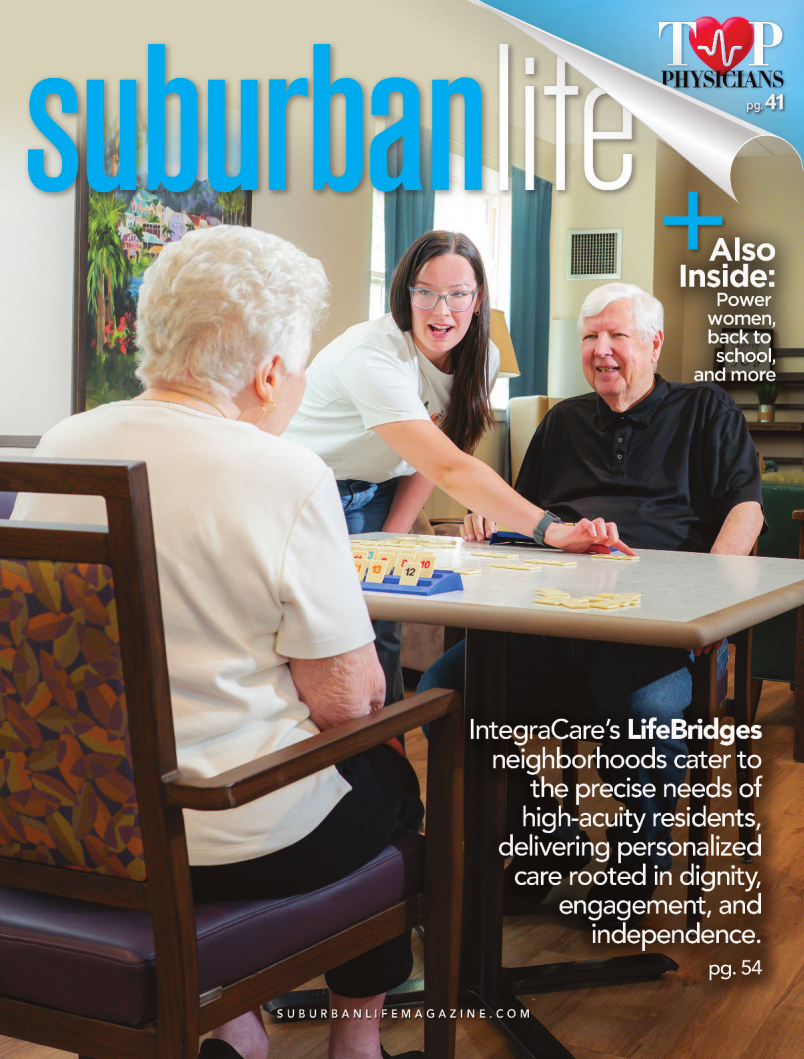
IntegraCare’s LifeBridges neighborhoods cater to the precise needs of high-acuity residents, delivering personalized care rooted in dignity, engagement, and independence.
Life expectancy in the United States has hit an all-time high, according to a recent report from Scientific American, with the average American born in 2024 expected to reach 79 years of age. With longer life, however, comes a likelihood of declining mobility and a higher risk of significant health concerns requiring specialized care.
IntegraCare, which operates 17 senior living communities in Maryland, Virginia, and Pennsylvania, has cultivated a program called LifeBridges to solve a pressing issue: High-acuity seniors may need a lot of hands-on care, but do they necessarily need to live in a nursing home?
As a bridge between personal care and skilled care, LifeBridges delivers 24/7 wellness and preventative care in a supportive and comfortable “neighborhood” at each IntegraCare campus. All of IntegraCare’s Philadelphia-area campuses—including Exton Senior Living and Glen Mills Senior Living—have LifeBridges neighborhoods, each capable of caring for as many as 18 residents.
Championed by IntegraCare Chief Operating Officer Belinda McQuaide and CEO Larry Rouvelas, the evolution of LifeBridges grew out of a simple yet deeply personal question: Would we want our loved one to be in this program?
“That’s the gut check, the lens we determine how to build out our programming,” says McQuaide. “The people appropriate for LifeBridges are not yet needing skilled care, yet that is where they often end up. Our LifeBridges neighborhood provides a much more residential-like feel. We’ve invested a lot of time and energy into getting this program right and are proud of the void it fills in the market.”
McQuaide comes from a clinical background; she previously worked as director of operations and analytics for the University of Pittsburgh Medical Center and as a researcher at the University of Pittsburgh. She describes LifeBridges as “my biggest passion.” Although the program existed prior to her joining the organization in 2019, it has flourished in the years since. LifeBridges began as an option solely for internal residents and has since become available to people from outside the community, including skilled-care and rehabilitation facilities.
Each LifeBridges neighborhood is staffed by highly trained professionals who provide specialized assistance with everyday medical care, nourishment and hydration, and emotional support. In addition, a network of off-campus medical professionals make regular visits to deliver “direct to you” specialty medical support for everything from dentistry and podiatry to audiology and optometry to physical therapy and mental health.
Having all high-acuity residents located in the same proximity helps to maximize response times for emergencies as well as regular preventive care, such as daily hydration rounds, weekly skin-integrity checks, and close monitoring for falls, infections, and decline risks. A higher standard of staff training has been instrumental in meeting those goals, according to McQuaide.
“In order to effectively care for LifeBridges residents, our staff needed to be trained and educated, and that includes every member of the team, because we’re all responsible for residents’ care,” she says. “We wanted to create a pathway for our team members so, much like memory care, you can become a LifeBridges specialist, pertaining to everything from transfers and lifts to dining support and texture support to deescalation. We also focus on slow processing communication, because oftentimes residents who had a stroke still have the ability to communicate, but it’s very different.”
Dining with dignity is a core tenet of LifeBridges. Rather than treating meals solely as the means to deliver nourishment, McQuaide believes dining for a high-acuity patient should be treated as a special event.
“People look forward to their meals, and that doesn’t change just because someone moves to a different neighborhood in the community,” she says. “It’s still an important part of the human experience, and we want to preserve their dignity and independence as much as possible.”
In order to make that happen, IntegraCare has incorporated specialized equipment so LifeBridges residents can fully participate in their meals—namely, nonskid plates, weighted utensils, two-handed cups, and plate guards to accommodate one-handed eating.
One of the program’s most consequential elements involves a renewed focus on food presentation. McQuaide cites an experience in which the company gathered its food directors to sample the same kinds of texture-modified foods—purees and other soft, palatable items—served to residents who have trouble chewing or swallowing. The food directors were, in a word, repulsed.
“We all eat with our eyes, so when these residents are served a meal and see a pureed diet, no wonder their intake is poor,” McQuaide says. “We’ve gone down the path of taking food molds to recreate the natural appearance of foods; a carrot should look like a carrot, and fruit should look like fruit, to maintain that sense of normalcy.”
Making that one adjustment, altering the appearance of food items on a LifeBridges resident’s plate, has greatly improved food intake. McQuaide estimates that the percentage has climbed from approximately 60 percent to nearly 90 percent.
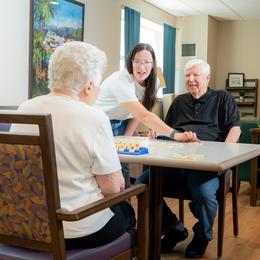
Dining with dignity also means opportunities to socialize in shared dining areas. In each community’s LifeBridges neighborhood, staff put a lot of thought into where residents sit and with whom. While staff are there to provide assistance with posture and swallowing support, if needed, they also prioritize residents’ independence.
“We never want to take away someone’s ability to do something for themselves,” McQuaide adds. “We’re never going to rush you through a meal just so you can move on to the next thing. Some individuals need more time to eat their meal, but they can do it if given the time—and most of them want to do it.”
IntegraCare provides other opportunities for engagement and socialization. This includes guided stretching and other exercises, as well as celebrations surrounding the winter holidays. Communities also utilize an interactive technology called Lucynt to offer mind-stimulating games to promote feelings of connection and purpose; the games have become popular during family visits.
LifeBridges has received positive feedback from residents’ families, especially those who previously cared for their loved ones at home, according to McQuaide. Now, family members can visit their loved one in a safe, comfortable environment, even enjoying meals together. With staff monitoring and assessing residents so closely, they can help make the determination if a loved one ever needs to be elevated to a more specialized environment, like skilled care.
McQuaide looks forward to LifeBridges’ continued evolution. She sees particular opportunities in expanding support for specific illnesses and comorbidities, such as Parkinson’s disease.
“Families want the best possible care for their loved ones, and we want the same,” she says. “There are situations where I see good actors taking high-acuity patients, but there is a distinct difference between taking high acuity and having a higher program built around the success of high-acuity patients. Cohorting all these people together, with all the staff and resources needed to support them, helps us ensure that these individuals do get the best possible care.
“We’re always challenging ourselves to learn and asking ourselves, ‘What can we do better to make this a more enjoyable experience?’” she continues. “I think this will be the future of our industry. People’s care needs are changing, and their comorbidities are changing. This is the next step in the evolution of the care we provide to address those changes.”
Exton Senior Living
600 N. Pottstown Pike
Exton, PA 19341
(610) 851-4233
www.extonseniorliving.com
Glen Mills Senior Living
242 Baltimore Pike
Glen Mills, PA 19342
(610) 851-4233
www.glenmillsseniorliving.com
600 N. Pottstown Pike
Exton, PA 19341
(610) 851-4233
www.extonseniorliving.com
Glen Mills Senior Living
242 Baltimore Pike
Glen Mills, PA 19342
(610) 851-4233
www.glenmillsseniorliving.com
Photo by Jody Robinson
Published (and copyrighted) in Suburban Life, August 2026.