Nothing to Fear
YA horror writer Nicole M. Wolverton looks on the bright side of getting scared.
Nicole M. Wolverton’s first short story—“drawn rather than written,” she says, “because it was before I could actually write”—featured a character named Mona, an imaginary friend who had red hair and knives for fingers. Although Mona didn’t use her knife-fingers for nefarious purposes, the story’s dark creativity was a sign of things to come.
“I was sort of doomed from the beginning, because my grandmother used to read me the original Grimms’ Fairy Tales,” Wolverton says. “Also, my grandmother was a huge Alfred Hitchcock fan, so there were always Alfred Hitchcock films playing in the background when I was at her house. You can’t be watching Alfred Hitchcock and hearing Grimms’ Fairy Tales without taking a dark turn.”
Wolverton, a native of east-central Pennsylvania who now lives in Delaware County, writes horror for young adults. Her novels include A Misfortune of Lake Monsters and, as of March 2027, Meat Sweats, about a vegetarian who accidentally turns into a cannibal.
A fixture in local and regional literary circles, Wolverton will have participated in nearly two dozen in-person events by year’s end, after which she will take “a well-deserved break.” Up next on her calendar: the Vampire’s Library Horror Book Fair, to be held on the grounds of Doylestown’s VAMPA Museum on September 26; a book signing at Thrillerdelphia in Manayunk on September 27; and the “Supporting Reluctant Readers Through Scary Stories” panel with fellow authors Laura Parnum and Diana Rodriguez Wallach at the 2026 Pennsylvania Library Association Annual Conference in Harrisburg on October 6.
Q&A
Horror has been on fire the past several years. Why do you think the genre is doing so well at this moment in time?
There is a proven flashpoint showing that when things are horrifying in the real world, horror becomes more popular. … There are also scholarly efforts put into understanding that when you consume a lot of horror media, you are training yourself to be calmer in horrifying situations. When someone watches a horror film or reads a horror novel, you’re doing so from a safe space, and for every minute of horror media you consume, your body produces less cortisol, your heart rate stays lower, and there are a whole bunch of other physiological and psychological issues at work there. … Even if people don’t really understand those mechanisms at work in the background, they certainly realize that when they watch a horror film, real life doesn’t seem so horrifying. Because things could be worse.
As a vegetarian, I’m fascinated by your forthcoming book, Meat Sweats. Tell me about it.
The basic premise is that our protagonist, Violet, has an elderly neighbor she’s good buddies with who is also a militant vegetarian, or so she thinks. The neighbor passes away and Violet inherits her entire house. While she’s cleaning out the house, she takes a bite of cake that this neighbor has left in the fridge, and it’s a special cake no one is ever allowed to eat, and from that cake she develops cannibalism. She turns into an accidental cannibal. What I will tell you is that by the end of the book, she finds a way to use the cannibalism for the greater good.
My husband and I got married in the year 2000. We had this gorgeous cake, it was so good, but the bakery that made it for us went out of business shortly after the wedding. You know the custom of keeping a slice of your wedding cake in the freezer and then eating it on the anniversary, right? We accidentally forgot to eat the cake at our one-year anniversary, so the cake has followed us from house to house, apartment to apartment. It’s now 2026 and I still have two slices of this cake in the freezer. … That’s what sparked this idea: What would happen if I ate this cake now?
You have one of the most interesting educational backgrounds I’ve seen, including a master’s in storytelling, horror, and society from the University of Pennsylvania. You’re also in the process of getting your Master of Philosophy in gastrohorror. What have you learned from those experiences?
For my first master’s, I looked at the research coming out of the Recreational Fear Lab in Denmark, around horror and resilience. I had been hospitalized with COVID that first year [of the pandemic], before the vaccinations came out. I got lucky to be sick when I did; it was toward the end of the year and people knew better how to treat it. While I was in the hospital, I kind of joked about it. I couldn’t quite understand why I thought it was funny and coping with everything with dark humor, rather than being really scared and really nervous about what could happen. Shortly after I got out of the hospital, I read the paper from the Recreational Fear Lab that talked about how horror consumers were more resilient during the COVID pandemic; they demonstrated better resilience. Then it sort of snapped to me. That’s why I’m very calm under pressure.
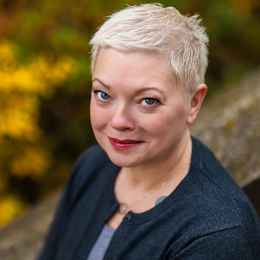
Photo by Laurel Harrish
Published (and copyrighted) in Suburban Life, September 2026.