Focused on ‘What’s Next’
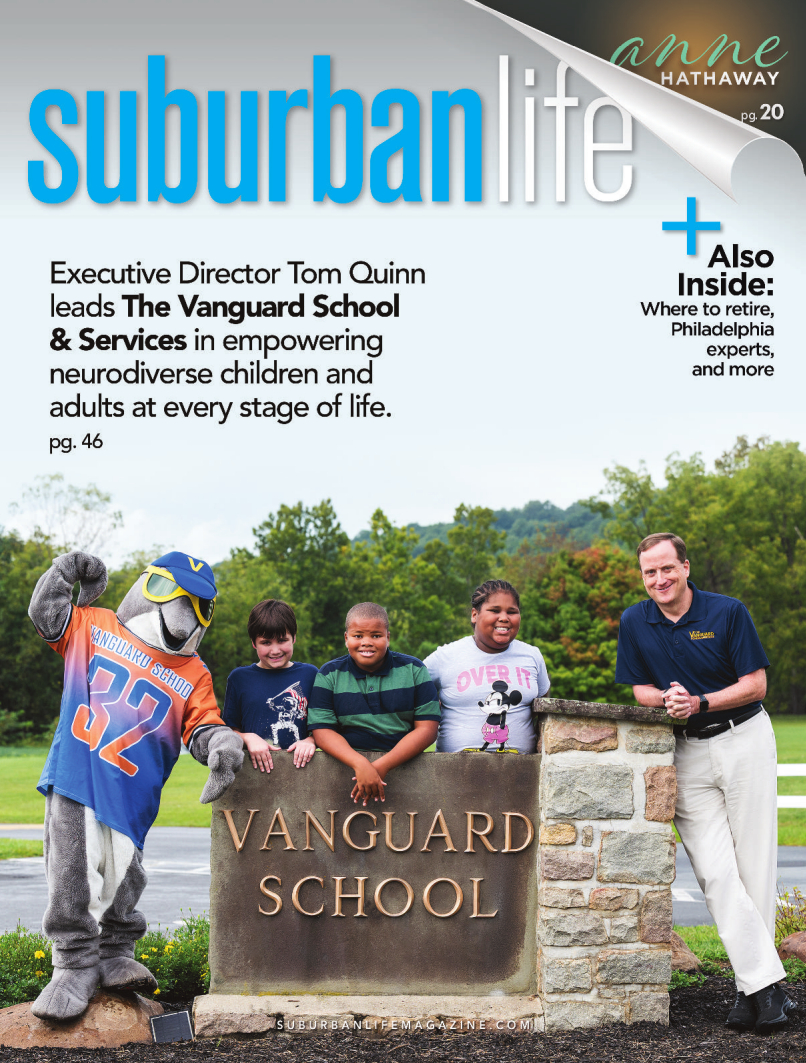
Executive Director Tom Quinn leads The Vanguard School & Services in empowering neurodiverse children and adults at every stage of life.
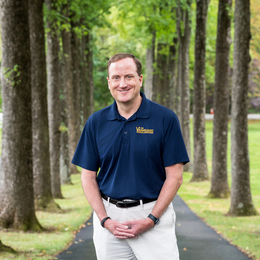
In his role as executive director of The Vanguard School & Services (VSS), Tom Quinn approaches each day driven by the same forward-looking question: “What’s next?”
The question applies to the education and resources the Malvern-based organization provides to neurodiverse children and young adults, ages five to 22, as well as postsecondary transition support and recreation services for members of the neurodiverse community. On a more granular level, the question extends to how equipped each student is to move through life once he or she leaves VSS behind.
The stakes are significant. Under the Individuals with Disabilities Education Act, neurodiverse children are entitled to a free public education designed to meet their specific needs and prepare them for further education, employment, and independent living. When the individual reaches 22, entitlement ends and they must apply for eligibility—and Quinn says the process of that change can be challenging.
“For these students and their families, it can feel like falling off a cliff,” he adds. “We’re able to do all these wonderful things for a child’s educational journey while they’re with us, but what’s the point if we’re not getting them ready for their life once they turn 22? They need to have the agency to navigate a complex system in order to get the services they need.”
Before stepping into his current role in the summer of 2024, Quinn served as president of the HMS School for Children with Cerebral Palsy in Philadelphia. Prior to that he worked as director of education for another Philadelphia-based institution, Walnut Street Theatre. At VSS, he sees an opportunity to make a broader impact for a population that has been historically underserved.
Quinn has the support of a staff of more than 300, including educators experienced in working with neurodiverse students, as well as behavioral experts and specialists in physical, occupational, and speech therapy. Together they aim to ensure that each of the 235 children currently in VSS’s care has the tools needed to move forward. Quinn describes the work as “a genuine calling.”
“This is a campus of great joy, and I’m amazed every day by what happens here,” he says. “There’s an awesome sense of mission. We’re making a difference by focusing not on what’s happening now, but on what happens next. It’s not necessarily a change in mindset but a change in understanding of the true impact of what we do: giving kids with challenges the right environment to grow and prepare not only for tomorrow, but for the 40 years after they leave us.”
VSS strives to achieve that goal by focusing on the “transition years” of 18 to 22, which is distinct from VSS’s high school program. Revamped programming is designed to answer a fundamental question based on each family’s goal for their child: “What do we want each student to leave The Vanguard School with?” One student’s programming will be rooted in finding and maintaining employment, while another’s will focus on building life skills.
“Obviously, when a child is six or seven years old, you don’t know what their path will be, but we want parents to start thinking about that as early as possible,” Quinn says. “They have to work with us to imagine what their child’s life will look like. The transition begins the moment there’s a diagnosis.”
Quinn cites a student named Anthony. After Anthony expressed an interest in becoming a professional mascot, VSS used available grant money to arrange for him to attend a “mascot camp” at Millersville University. He then had an opportunity to work as a mascot at a minor league baseball game. Today, Anthony fills the role of VSS’s mascot, Phin the Dolphin, while he explores other interests, such as the possibility of a career as an auto mechanic.
VSS continues to prioritize employment opportunities for students, both on and off campus. On-campus examples include a student-run café (Phin’s Café) and a carwash and detailing enterprise (Phin’s Garage), both of which were created through grants from the Eagles Autism Foundation. Off campus, VSS has formed close partnerships with dozens of local businesses that offer opportunities for career exploration and skills development.
The first-ever Inclusion Market will showcase the strength of VSS’s partnerships. Held on October 10, VSS’s outdoor market will welcome to the campus an array of neuroinclusive vendors of food, artwork, and woodwork, among other items. The event, which is completely open to the public, will be a celebration of inclusion, creativity, and possibility.
Some of VSS’s most important work happens out of public view. Beginning this year, VSS will host sessions with families to complete the necessary paperwork so their children can find, connect with, and monitor the community resources and medical care they need for age 22 and beyond.
“Oftentimes parents of kids with autism feel like they’re constantly given a list of things to do and apply for, so completing this paperwork on their own becomes just one more thing to add to the list,” Quinn says. “With these sessions, they can get everything in order so they are prepared before their child leaves a school like ours. This applies to families of students of all ages; there’s nothing that says you need to wait until a certain age in order to start preparing.”
VSS collaborates with the Pennsylvania State Department of Education and nearly 60 partner school districts to ensure resources of the highest quality. It also works closely with lawmakers in Harrisburg. For example, Quinn advised Pennsylvania Rep. Napoleon J. Nelson on the creation of a three-bill package that seeks to alter the language of the Fiscal Code of 1929. If approved, the legislation would change how a school such as VSS is characterized, from “approved private school” to “approved special education school.” Quinn says it’s an important distinction designed to protect funding.
“The legislation is about making sure we’re part of the conversation to advocate for families,” he says. “Removing the moniker of private gives a better impression of who we are. I spend a lot of time explaining to people, ‘These are our students, and this is where our funding comes from.’ We’re a key part of making sure everyone in the school system gets the services they need. … [This legislation] will help reinforce that we’re a vital part of the public school system.”
Looking ahead, Quinn foresees a bold reimagining of the VSS campus. It will likely begin with a new VTC, short for Vanguard Transition Center, where young adults will receive targeted postsecondary education support, career preparation, and community-based vocational training, as well as social and daily living skills development. The school’s board of directors recently approved a capital campaign to raise funds for construction. Once the VTC is complete, a campuswide transformation will follow so VSS can better prepare future generations of neurodiverse individuals for every aspect of life.
“A student who came to VSS 20 years ago is much different than those who are at VSS now,” he says. “They have greater needs than they did 20 years ago. We have come so far in working for kids with autism, and we’re going to continue to serve those needs in every way we can. The kids we serve have significant challenges, and we’re committed to making sure they have the best outcomes possible.”
The Vanguard School & Services
1777 N. Valley Road
Malvern, PA 19355
(610) 296-6725
(610) 296-6725
Photo by Jeff Anderson
Published (and copyrighted) in Suburban Life, October 2026
Published (and copyrighted) in Suburban Life, October 2026