The Best of Both Worlds
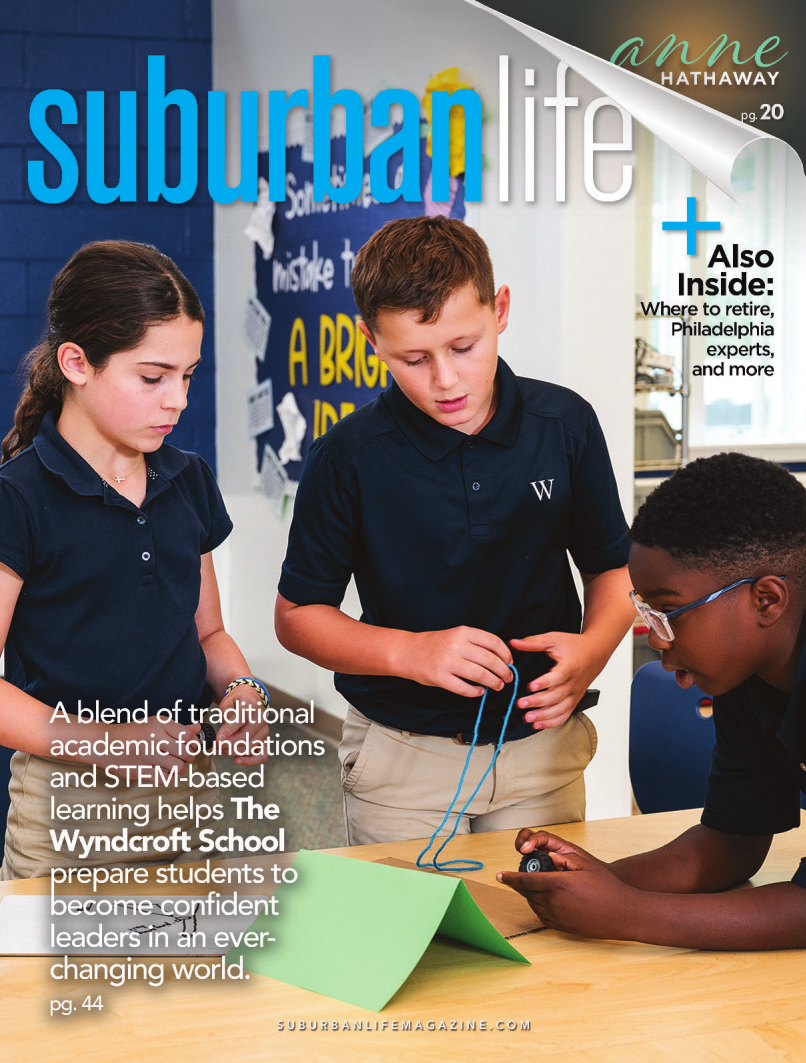
A blend of traditional academic foundations and STEM-based learning helps The Wyndcroft School prepare students to become confident leaders in an ever-changing world.
Children today are often held to impossibly high standards, and when they don’t reach those lofty heights, it is often assumed that something must be wrong. Yet making mistakes is an essential part of learning, which is why The Wyndcroft School takes a different approach.
Wyndcroft, a private elementary and middle school in Pottstown, encourages students to be curious, to experiment, to branch outside of their comfort zone, and yes, even to struggle or fail at times—all in the name of growth. An unplanned moment at this year’s opening assembly confirms that the lesson resonates with the student body.
After Head of School Wilson Felter unveiled the year’s theme of “Strong at the roots and ready for what’s next,” he turned the presentation over to music teacher Sarah Robinson to lead a rendition of the school song on the piano. Although Robinson is an outstanding singer and performer, she struggled at first; she had never before played the alma mater in front of a group, let alone the entire school community. Without prompting, the students started clapping for her and inspired her to keep going.
“She took a risk in front of the whole group, she was willing to be vulnerable, and she worked through it,” Felter says. “That’s the kind of school we are. We’re going to support you through that struggle, just like we supported Ms. Robinson. It was a touching moment to see the kids get behind her, and it was an impromptu example of how taking a risk can launch you to another level.”
What Children Still Need
While some schools emphasize basic academic foundations and others lean into technology and contemporary learning, Wyndcroft’s philosophy is that kids need both. Its educational model isn’t defined by one curriculum or program but aims to provide students with all the tools they will need to move forward.
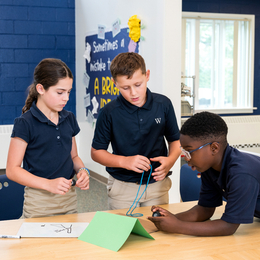
On a typical day at Wyndcroft, a visitor might see young children learning how to form letters correctly and strengthening their vocabulary in one classroom, while down the hall others are collaborating on a STEM design challenge and testing different theories.
Meanwhile, a strong mathematics program ensures that every student will graduate with a foundation in algebra and can possibly even start geometry. The world languages program offers French as early as age 3 and Latin starting in fifth grade.
“You walk through the hallways and you see kids engaging in what some people might call traditional work: pen and paper, spelling, and learning Latin,” Felter says. “Cursive writing went out of favor for a long time, and now there are many school districts in the country that are bringing it back because people are connecting it to cognition and memory.
“You also walk down the hall and you see kids coding or programming a robot,” he continues. “You see engineering and inquiry-based learning and discussion classes in our upper grades. That blend is alive and well here. We understand the importance of that balance and how it’s going to set kids up for success, first in high school and then in college, their career, and beyond.”
What Today’s Children Need Next
Shannon Stone believes in Wyndcroft’s mission, not only because she is in her ninth year as a teacher there, but also because her two sons attend the school—one in fourth grade, the other in kindergarten. As the school’s STEM coordinator, she leads a program that has components of engineering and robotics that has become a core class for every level.
In STEM, students may come up with their own design and build a prototype, program a robot, create a video, or devise a solution to a real-world problem while incorporating concepts from other classes like math and science. The goal is to get them thinking critically and creatively.
“I feel like that’s the heart of the program,” Stone says. “I purposely don’t ever give the students step-by-step directions. They’re asking a lot of questions, they’re brainstorming, they’re creating, they’re testing, they’re improving. I emphasize in my class that failure isn’t the opposite of success in STEM; it’s what we want to see to get more information. If we fail at something, it teaches us how to fix it or do it better.”
Stone loves the excitement her students bring to class every day for different projects, and it’s not just limited to school hours. Last year, a group of graduates founded a STEM Club at their high school and recruited a large number of classmates to join.
“It made me so happy to hear that,” Stone says. “I just love what I do here. It really is a special place.”
Why It Works at Wyndcroft
Director of Academic Program Dan Edleman has been both a teacher and an administrator during his 14 years at Wyndcroft. He appreciates how the school teaches students to think globally and act locally, and how to adapt to an ever-changing world.
“We’re preparing these children for jobs or careers or lives that we don’t even know about yet,” he says. “We have things that are ‘traditional’ that are good skills and competencies for young people to have as a foundation. Another part of our mission is to provide exposure and opportunity, and with that comes things that are new and innovative and have a chance for risk. With risk, there can be learning.”
The small class sizes allow for strong relationships to be formed among students and teachers. As a result, students build the competency and confidence needed to grow academically, socially, and emotionally.
“There’s a sense of community here that is really hard to put your finger on, because you just have to feel it,” Edleman says. “It’s a welcoming feeling and a feeling that you can try something here, be vulnerable, and think outside your comfort zone a little bit.”
One of Edleman’s favorite traditions at Wyndcroft is when a random act of kindness, such as a student helping a classmate pick up dropped books, is recognized at a school-wide assembly. It’s a core part of the values-based education centered on the school’s motto, Non Sibi, a Latin phrase meaning “not for oneself.” Each grade has a Non Sibi trait—kindness, empathy, grit, and resilience—that becomes a yearlong theme.
Students also visit local nonprofits, learn about their missions, and participate in service opportunities. Felter believes these real-world opportunities will better prepare students for their careers and their lives, “so we want to start that at a young age.”
Where Wyndcroft is Going
As a school with a 100-year-plus history that is rooted in tradition but also committed to innovation, Wyndcroft continues to prepare students for an ever-changing world.
“They leave this school as confident learners,” Stone says. “By the time they hit eighth grade, they’ve presented, they’ve collaborated, they’ve led in different ways. They will all encounter something unfamiliar outside of here and they might not know how to do it, but they’re confident enough to start figuring it out on their own.”
Whether they end up at a prestigious private high school or in their public district, Wyndcroft graduates are ready for the next step. Felter cites a compliment recently paid to his students by a local administrator.
“He said, ‘We know Wyndcroft kids as soon as we meet them: They’re thoughtful, they’re kind, and they’re leaders,’” Felter recalls. “Part of our mission is, where caring connections are made, innovation happens and leaders emerge. So I’m not surprised to hear that about our graduates.”
The Wyndcroft School
415 Rosedale Drive
Pottstown, PA 19464
(610) 326-0544
Photo by Jeff Anderson
Published (and copyrighted) in Suburban Life, October 2026
Published (and copyrighted) in Suburban Life, October 2026