
Nurtured by Nature
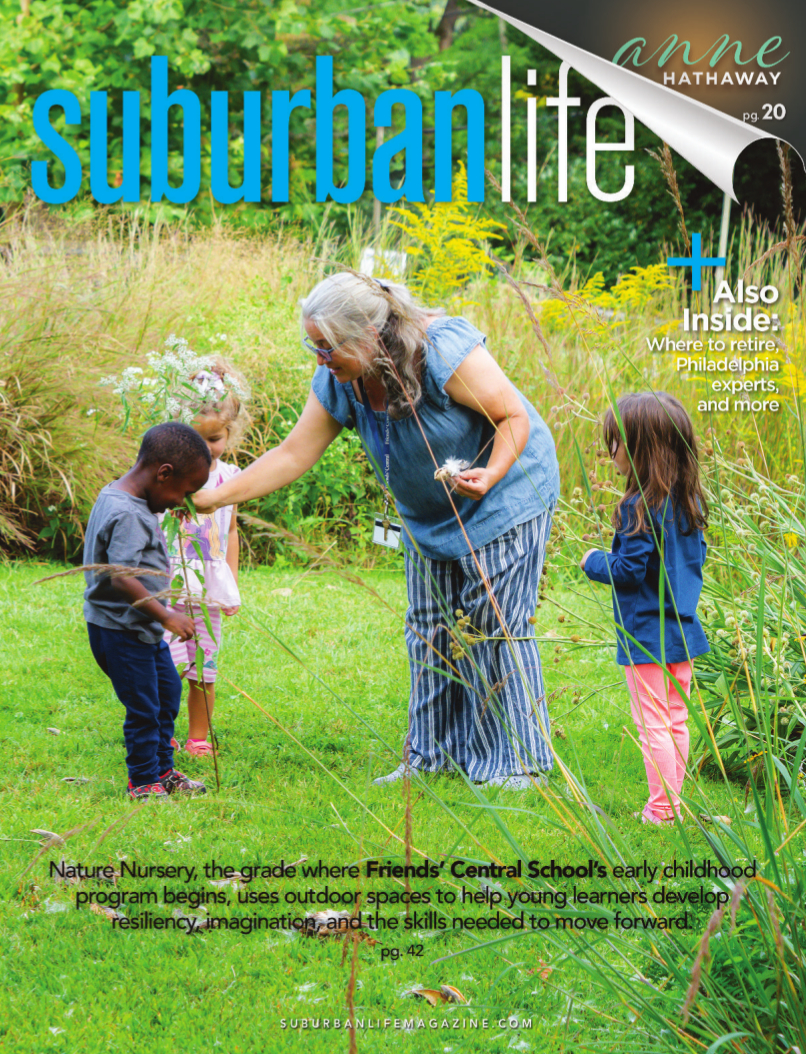
Nature Nursery, the grade where Friends’ Central School’s early childhood program begins, uses outdoor spaces to help young learners develop resiliency, imagination, and the skills needed to move forward.
Melody Regino Acinapura recalls her first visit to the Lower School campus of Friends’ Central School 11 years ago.
“I stumbled upon 18 acres of bucolic beauty on Old Gulph Road,” she says. “My kids were hopefuls then, now actuals, but I loved the idea of them spending their days on this campus, which has woods, a stream, a garden, and a pond where they can see turtles and fish, as well as a state-of-the-art makerspace. It felt like the most ideal place to raise a family.”
Fast-forward to 2026 and Acinapura is in her 10th year with FCS, her eighth as principal of the Lower School. She’s also the mother of two children, both of whom are enrolled at FCS—one in first grade and another in pre-kindergarten. Both children have been shaped by FCS’s thoughtful use of its bountiful outdoor spaces, particularly through the school’s Nature Nursery program.
Now in its sixth year, Nature Nursery represents the first of the Lower School’s early childhood programs, designed to foster a love of learning through time spent largely in outdoor settings; children spend as much as 70 percent of each school day outside. Whether inside or out, skilled educators work closely with children as young as two years and seven months as they navigate their first steps in the FCS community.
FCS’s Lower School once had a more traditional nursery program, which was scuttled so the school could “think about what we wanted it to be,” Acinapura says. The reimagined program, based on the school’s decision to entwine the curriculum with the natural world, became Nature Nursery.
“My daughter was born in 2019, right before the COVID-19 pandemic,” Acinapura says. “If you had asked me before [the pandemic] if an outdoor program was important, I don’t know if I would have said yes. But if you look at the research, it shows that time outside helps children learn best. The natural world inspires curiosity, creates a sense of calm, and makes the nervous system happy.”
Through Nature Nursery, learning opportunities unfold in meaningful and often unpredictable ways. Falling leaves in autumn present opportunities to discuss Earth’s rotation, seasonal weather patterns, or even climate change. A rock rolling downhill gives an educator a teachable way to explain kinetic energy and other scientific principles. A butterfly seen on a nature walk helps students learn about the intimate relationship between native flora and fauna, or biological concepts such as metamorphosis.
“The natural world enables us to teach complex things,” Acinapura says. “It also helps us make the lessons more real, as opposed to learning them on a screen, which can be detrimental. … The outdoors is a place where kids can take healthy risks and use their imagination.”
Beyond a love of nature and a sense of wonder in the world around them, students develop social skills, learn resiliency, and spark an interest in critical subjects that will carry them forward—namely, the arts, language, math, and science.
Families have been “delighted” with the program, according to Acinapura. The only downside, she jokes, is that families can expect to do “a lot of laundry,” because students have ample opportunities to get their hands—and everything else—dirty. That’s why every family receives a packing list so each child can be adequately prepared for the school day.
“Even on the coldest days, students will be outside for appropriate blocks of time,” she adds. “Even 15 minutes can give them a chance to have some outside fun. We’re of the mind that there’s is no such thing as bad weather, just clothes that aren’t prepared for the weather.”
Acinapura has seen the program’s benefits play out with her own children.
“Every day after dinner they still want to be outside,” she says. “The other day my daughter picked up a caterpillar off the ground and said, ‘Which plant will it feel better on? Which leaf will it want to eat?’ We want all our kids to be good students and good people; we need a lot more of that in the world right now.”
Nature Nursery lays the foundation for the rest of a child’s learning—a skill-building bridge to pre-kindergarten, kindergarten, and grades one through five. Just like their older peers in Lower School, Nature Nursery students explore subjects including physical education, music, and Spanish. Children also spend time in the Ulmer Family Light Lab makerspace and the library. They even have “book buddies” with older Lower School students, in which younger and older students read books together, as a way to foster community and promote deep learning.
“With every grade, we believe in thematic learning, and we are clear about the skills we want students to have at the end of that experience,” Acinapura says. “Every student has a growth portrait, which consists of social and emotional learning and hard skills. We want them to be readers, writers, and mathematicians. With Nature Nursery, we’re really teaching children how to be natural learners, so by the time they get to pre-kindergarten they can approach learning with a sense of wonder.”
Lower School students continue to use the outdoor campus as a classroom after they graduate from Nature Nursery, just not as frequently. As Acinapura puts it, “The magic doesn’t end in Nature Nursery.” While the FCS Lower School is independent of the Middle and Upper School campus, both campuses share common goals: to foster independence, promote joy, and help students prepare for the next phase of their lives.
“That’s why I say it’s worthwhile to look at a school’s Upper and Middle Schools, even if you’re looking for a place for a child who’s only two years old,” she says. “There was a panel of rising seniors at a recent open house, and I knew all of the students on the panel. They all talked about finding what they loved at Friends’ Central, and that started while they were in Lower School.”
Friends’ Central School
Lower School Campus (Nursery–Grade 5)
228 Old Gulph Road, Wynnewood
(610) 642-1018
Middle & Upper School Campus (Grades 6–12)
1101 City Ave., Wynnewood
(610) 645-5032
Photo by Jody Robinson
Published (and copyrighted) in Suburban Life, October 2026