

Best of the Brandywine Valley
Behold the area’s vast natural beauty.
The rolling hills, family farms, and open spaces of the Brandywine Valley have inspired countless painters and other artists, including those not named Wyeth. Given the area’s immense beauty, it’s no surprise artists who lived in or visited the Brandywine Valley would be compelled to capture its essence so others could appreciate it.
Spanning two states and multiple counties, the Brandywine Valley abounds with parks, estates, arboreta, and other wild or semi-wild spaces that enable visitors to form a direct connection with the world around them. Many of them are featured here.
Luckily, many of the region’s most jaw-dropping tracts of land have been permanently preserved, meaning they will endure for the enjoyment of generations to come.
Miles of hiking trails. Check. Old-growth forest. Check. Meadows galore. Check. Ready access to the Brandywine Creek. Check. Welcome to Brandywine Creek State Park. Whether you’re into mountain biking in the summer, cross-country skiing in the winter, or birding year-round, you’ll find what you’re looking for here. The park is known for the iconic blue gneiss stone walls bisecting its meadowlands, as well as a preserve of tulip poplars thought to be more than 200 years old. Like many of the remarkable open spaces in and around Wilmington, the park has a rich history linked to a famous last name in these parts: du Pont. destateparks.com
Inside the Brandywine Museum of Art, visitors can view captivating works of American art, particularly from artists who honed their craft in the Brandywine Valley; whole galleries are devoted to the works of the Wyeth family—N.C., Andrew, and Jamie. Yet some of this Chadds Ford cultural institution’s finest works are outside the walls of the museum, which was hued from a renovated 19th century mill. The 15-acre campus includes walking trails, gardens flush with wildflowers and native plants, and nonstop views of the Brandywine River. brandywine.org
The ancestral home of the du Pont family, the Hagley Museum and Library is situated on more than 230 acres of Wilmington soil. Visitors can expect an experience that takes them both indoors and out. Delve into the property’s past as a gunpowder factory. Wander the French-style gardens. And, for those eager for more, get a behind-the-scenes look by way of a private tour and learn about the property and the people who once lived there. hagley.org
We’re suckers for a good love story, especially when the story continues to bloom, season after season. Jenkins Arboretum and Gardens in Devon traces its 20th century roots to the home of H. Lawrence and Elisabeth Phillippe Jenkins. Even back then the property was populated by abundant trees, shrubs, and other flora. After Elisabeth’s death in 1963, Lawrence knew he wanted to preserve the property as a tribute to his late wife. Today, the 20-acre property is not only a beautiful place to visit, but a model of horticultural and environmental stewardship, with an emphasis on native flora. jenkinsarboretum.org
Natural places are worth visiting all year long; some of the most memorable visits can be in the dead of winter, not only because there’s more elbow room, but because the landscapes are just as vibrant, only in different ways than spring, autumn, and summer. Even on the coldest and grayest days of winter, Longwood Gardens pops with color and life. There’s something to be seen and experienced around every corner, both indoors and out. While much of the world around us is mired in conflict, this Kennett Square destination represents a near-perfect balance between wildness and curation, an example of humanity and nature dancing to the same tune. There’s a word for that: harmony. longwoodgardens.org
Located on the same campus as Nemours Children’s Hospital in Wilmington, the Nemours Estate is reminiscent of the Biltmore in Asheville, North Carolina. The estate features more than 200 acres of French-inspired formal gardens, woodlands, and precious landscapes, as well as a 47,000-square-foot, 77-room mansion dating back to 1910. Both inside and out, the Nemours Estate is a breathtaking place well worth a visit. nemoursestate.org
Walking the streets of Saint Peter’s Village, in Elverson, feels like a step back into a simpler time. Quiet and quaint, St. Pete’s has boutiques, a bakery, and a vintage arcade, though double-check the businesses’ open and close times before you go. It’s also a good jumping-off point to nearby outdoor attractions, like the Saint Pete’s Trail, French Creek State Park, and Hopewell Furnace National Historic Site. brandywinevalley.com
It’s a wonderful thing when the natural world reclaims spaces once seized by human progress. Take Chester County’s Struble Trail, an out-and-back stretch of a little more than five miles that sits on the original railbed of the Waynesburg Rail Line. Ideal for running, biking, and simply enjoying nature, the trail runs alongside the east branch of the Brandywine Creek for much of its span. chesco.org
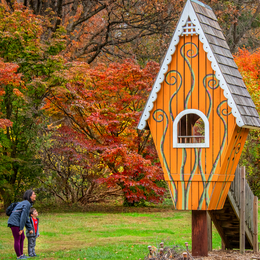
Want to form a deeper connection with the natural world? Head to Tyler Arboretum in Media for 650 acres of woodlands, wetlands, and spacious meadows. Also, through October 2027, the grounds will feature the mammoth sculptures of Steve Tobin, a Bucks County artist whose distinctive works have taken root in Pennsylvania, New York, and as far away as China. tylerarboretum.org
Perhaps the centerpiece of the Winterthur Museum, Garden and Library—another Delaware property with a direct link to the du Ponts—is the naturalistic garden. This makes sense considering that gardening was considered the first love of its founder, Henry Francis du Pont. The 60-acre garden, which can be seen either on foot or by tram, is surrounded by close to 1,000 acres of farmland, open meadows, and waterways, much of which can be seen by hiking the property’s trail system. winterthur.org
Photo of Tyler Arboretum photo courtesy of Visit Philadelphia
Published (and copyrighted) in Suburban Life, October 2026