
A Wealth of Possibilities
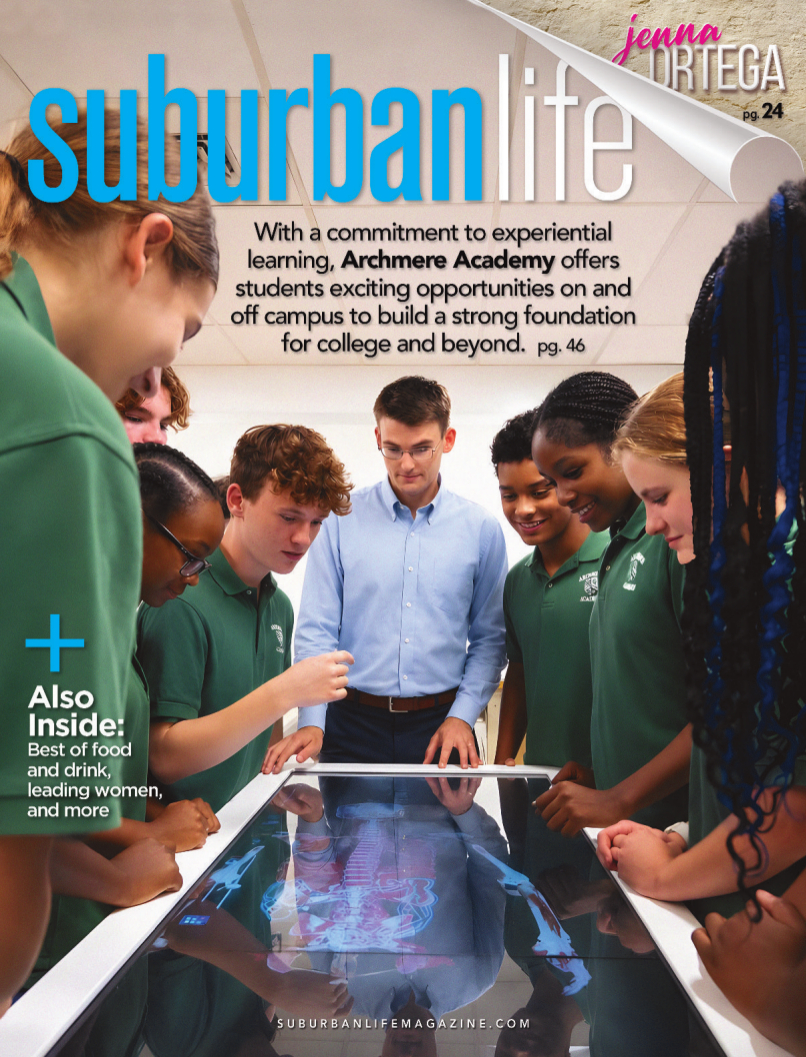
With a commitment to experiential learning, Archmere Academy offers students exciting opportunities on and off campus to build a strong foundation for college and beyond.
For anyone interested in pursuing a career in medicine, there is a major difference between reading about cancer in a textbook and examining actual case studies alongside doctors and researchers from one of the most renowned pediatric hospitals in the country.
Similarly, aspiring engineers can learn more from designing a solution to a real-world problem presented by a professional in the field than by completing a hypothetical assignment. And for those studying a foreign language, spending time with a host family halfway around the world can turn vocabulary and grammar lessons into something far more meaningful.
All of those examples are currently part of the curriculum at Archmere Academy, a private, Catholic college preparatory school in Claymont, Delaware, that is approaching the 100th anniversary of its founding. The school has thrived for so long by embracing its unique traditions, but also by adapting its educational philosophy to give students the foundation they need for success in college and beyond.
“Our goal at Archmere is to always be on the cutting edge and to always be evolving,” says Katie Eissler, who is in her seventh year as principal and her 13th overall at the school. “Whatever that might look like and whatever the world may need from this generation of learners, we’re going to provide it. The things we are talking about today might be totally different in five years as the world evolves, but we are called at Archmere to take up that torch for students in an ever-changing global society.”
Archmere has long prided itself on delivering a boutique educational experience through small class sizes, local field trips, and exchange programs with schools abroad. In recent years, however, the school has leaned even more into the concept of experiential learning, particularly on its own campus.
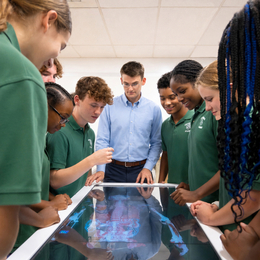
Look no further than the Anatomage Table, a virtual dissection and 3D learning platform that features digitized human cadavers. The technology has been embedded into most of the science courses at Archmere and allows students to study actual human biology and medical procedures such as ultrasound and MRI.
“It’s something that you might find at medical colleges; you don’t really come across that very much in high school,” says Matthew Wilcox, Ph.D., a physics teacher and the chair of Archmere’s science department. “It’s an incredible resource. Everybody I’ve seen use it is just in awe of its capability.”
Some of the course offerings also have a college feel. Advanced Cancer Research and Analysis (ACRA) was developed in collaboration with Phillip “Jay” Storm, M.D., an Archmere graduate and the chief of neurosurgery at Children’s Hospital of Philadelphia (CHOP). Most of the students who enroll in the class hope to attend medical school, and it gives them an in-depth look not only at the biology of cancer but also scientific research and data analysis pertaining to medicine.
ACRA includes guest lecturers from CHOP, students are encouraged to email Dr. Storm with any questions. He also hosts a party for students and their parents for further networking opportunities with doctors. Six students are also chosen for two-week, paid summer internships at CHOP.
“When this class first started, the first year was great, but secretly I was thinking it would get boring to the kids after it was no longer the shiny new program,” Dr. Wilcox says. “But honestly, it’s gotten better every single year. The connection has remained and it’s grown stronger with more people. Dr. Storm has not relented in his enthusiasm for this course, and I can see this going on and on.”
Advanced Engineering Design and Practicum is another course that enlists professionals from the industry to act as mentors and engage with students. The course challenges students to tackle real-world problems and expand their ability to think critically.
Then there’s the Global Studies initiative, a multidisciplinary program tailored around foreign languages, different cultures and religions, social justice, and community impact. Archmere offers travel opportunities geared toward linguistic study, service, and even specific subjects such as engineering or environmental science. Past countries visited include Belize, Costa Rica, Iceland, Italy, and Spain, while upcoming trips are scheduled for Greece, Japan, and Nicaragua.
Eissler, who is also a French teacher, was fortunate enough to visit France as a high school student. The experience changed the course of her life. She hopes Archmere students who pursue opportunities to travel abroad are similarly affected.
“I think travel in particular and language study in particular are directly related to one’s depth of empathy,” she says. “One of the things we say in our mission statement is that Archmere students should be ‘an empathetic leader prepared for every good work.’ I know that sounds like a very broad statement, but I think it means that students need an ethical framework for how to operate in the world and an understanding for what it means to be a global citizen and an open-minded individual.
“Families come here even if they are not Catholic because they know they’re going to have that ethical and moral framework that lifts up and supports everything that we do,” she continues. “I think the global studies component is deeply connected to that.”
Of course, with Archmere’s commitment to experiential learning, students don’t have to venture far at all to reap the benefits of learning through doing, discovery, and exploration.
“We want students to know, if travel is not for you, those other experiential opportunities are something you can soak up without having to go anywhere,” Eissler adds. “We want to make sure it’s an equitable opportunity that all of our students have access to.”
Archmere is a place where students can sharpen their academic skills, find their passion, and perhaps discover their future path—or even figure out what they don’t want to study at the next level. Whatever they experience, they are sure to have the backing of the administration and educators, as well as each other.
“I have never seen anybody here get down on their fellow students,” says Dr. Wilcox, who is in his eighth year at Archmere. “I think we’re all very supportive of each other in all facets, whether it be sports, school, or our robotics team, which was nonexistent two years ago and has already become a state champion. This is just an incredible community.”
Archmere Academy
3600 Philadelphia Pike
Claymont, DE 19703
(302) 798-6632
Photo courtesy of Archmere Academy
Published (and copyrighted) in Suburban Life, November 2026