A Very Special Book
Camille Acker’s new novel explores “the stories we tell ourselves about who we are.”
Writer Camille Acker isn’t afraid of the tough questions: How do we define who we are? How do we deal with shifting understandings of our personal histories? Which East Coast city has the best pizza? These are just some of the questions (OK, maybe not the pizza one) that come up in Acker’s latest book, A Very Special Episode, published in August 2026.
Originally from Washington, D.C., and a graduate of Howard University and New Mexico State University, Acker burst on to the literary scene in 2018 with her critically acclaimed short-story collection Training School for Negro Girls. But she wanted to try her hand at a novel.
“I have often said that writing a short story for me is like exploring a room in the dark; I bump into a table and find the plot,” she says. “Writing a novel was like exploring a dark mansion.”
Lucky for readers, Acker’s explorations resulted in her new novel, A Very Special Episode, a sinister tale following Nina Johnson, a young heir to one of the D.C.’s most influential Black institutions, as she seeks to secure her future and her family’s legacy by partnering with a shadowy organization, only to discover that they may be asking far more than Nina’s willing to give. We caught up with Acker to talk about the spark for her novel, how she started as a writer, and, yes, pizza.
Q&A
In your novel, A Very Special Episode—great title, by the way—you explore the interplay of race, class, and family legacy set in the heart of Washington, D.C.’s Black elite society. What compelled you to write this story?
The desire to write this novel started some years ago with a simple, but bold premise: Five Black women save the world. What it evolved into over years of writing, rewriting, throwing away, more writing, and an incredible amount of revision was four Black women, who are family and friends, discovering and ultimately foiling a shady organization’s evil plot. A lot of the novel is about the stories we tell ourselves about who we are. We form our identities from our families, from society, from culture, and we take all of that and build our values and life choices on that structure. In my novel, the main character, Nina, comes to realize that a lot of the stories she’s based her self-image on are not true or at least not as true as she thought. When she’s confronted with that, she isn’t quite sure what to do. Does she put in the effort to be different and make different choices, or will she cling to the way she’s always been because it’s easier and makes her feel safer?
This book is satire. What made you excited to write in this genre?
I was raised in a family where we watched the evening news at dinner and discussed it afterwards. Those conversations could be serious but also always had a healthy dose of humor. I love that satire can do that, make you think and make you laugh. Especially in these times where life can feel absurd and outlandish, satire feels like the best genre to capture the strangeness of this era. My writing life has also been deeply influenced by great satirical writing, including Erasure by Percival Everett, The Sellout by Paul Beatty, Loving Day by Mat Johnson, and New People by Danzy Senna.
Why did you first start writing?
Even as a kid, I was an observer. Curiosity and understanding guide the way I engage with the world. Writing is an excellent way to observe, indulge my curiosity, and arrive at some kind of understanding about the whys of the world. I’m also the child of two bibliophiles, so books were in nearly every room of my childhood home and still are. I was also lucky enough to get encouragement from teachers at an early age about my writing, which led me to decide in fifth grade that I wanted to be a writer.
This book is set in D.C., your hometown, but you currently live in Philadelphia and now teach at a Philly institution, Temple University. What’s special about creating art in this area?
Philly is rich with texture, from the streets to the people. There’s no shortage of landscape in this city to cultivate on the page. I’ve also found incredible artistic community here, writers, of course, but also filmmakers, visual artists, musicians, and fashion designers. A city that makes art and makes exceptional art is my kind of place.
Final question: D.C. or Philly pizza?
Oh, man. I’m going to have to disrespect both places and say New York pizza! But, given that I became a gluten-free goddess in recent years, Philly’s South Asian food scene is unmatched.
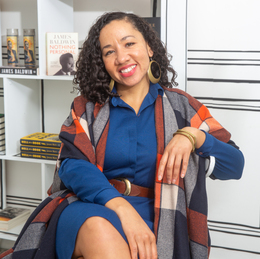
Photo by Neal Santos for The Pew Center for Arts & Heritage
Published (and copyrighted) in Suburban Life, November 2026