

A Step Back in Time
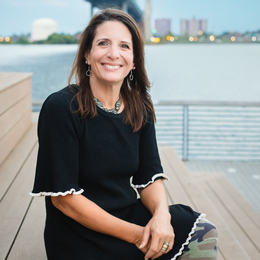
Natalie Pompilio gives native Philadelphians a glimpse into our nation’s rich history.
Gaze upon John Trumbull’s painting, Declaration of Independence (1818), and it’s easy to imagine the Founding Fathers living in a world that modern Americans couldn’t possibly relate to. This pivotal moment in our nation’s history was interrupted by horseflies the minute someone opened a window, according to journalist and author Natalie Pompilio.
“It’s easy for us, because we look back and we know how it all ends—like, you’re going to win this war, everything’s going to be fine,” she says. “But they were like us now, as we go forward every day, not knowing what tomorrow will bring. They didn’t either.”
Pompilio graduated from John Hopkins University’s undergraduate program with a bachelor’s in creative writing before attending journalism school in the University of Maryland. Eventually, her love for research led her to write Philadelphia: A Walk Through History, published by Reedy Press. The book encourages curious Philadelphians and visitors alike to explore the city’s lesser-known past by taking guided tours through town.
Q&A
You’ve worked with The Philadelphia Inquirer, Philadelphia Daily News, The Washington Post, and other notable publications. Who or what inspired you to pursue your career as a writer and editor?
I always wanted to be a writer. … I went to J school at the University of Maryland because I had no idea what good newspaper journalism was, and I just fell in love with it. I had a teacher from The New York Times who was very encouraging and was, like, “You’re gonna do this.” We just need that one person, you know?
You’ve mentioned you wanted to help others understand the historical blueprint of our nation through your work. What got you so interested in Philadelphia’s history that it prompted you to write your book?
Well, I have lived here longer than I’ve lived anywhere else. I also spent a lot of time in New Orleans, and a couple years ago I saw an advertisement for a book called Walking New Orleans. So, I applied for the job, and they said, “No, we don’t want someone who doesn’t live there all time. Will you do Philadelphia?” And it was good timing. So, my sister and I collaborated on it, and, I mean, being a journalist is being really nosy. And just being so amazed by everything.
Who are some historical figures you were previously unaware of before your research, and why do you want others to know their stories?
There’s a woman called Esther Reed. She’s in the “Founding Mothers” tour. She wrote a pamphlet called “The Sentiments of an American Woman” during the Revolutionary War. She was actually British-born, came over, married an American guy, and moved here with her mother. She had her own story, and she wrote, “As an American woman, we’ve got to give up these fripperies. We have to give everything to the war cause.” She paid to have it printed, put it out, and people were, like, “Yes, we do!” And she raised thousands of dollars. … Well, her husband worked with George Washington, and so she said, “OK, we’re gonna send the money to the soldiers.” And George Washington’s like, “Absolutely not. They all just used it on booze, but you could make them shirts.” They made 1,000 shirts, and each woman embroidered her name in the back of it so that soldier would know that someone was thinking of them and cared.
In your opinion, is there a specific part of Philadelphia’s history we choose to overlook? If so, why do you think it needs more attention?
I think we don’t know and talk about enough about our Black history because we’re so crucial to Black American life today. The founding of the American African American Methodist Church is here. We had some of the great educators here at the African American School. Octavius Catto did everything, and he was murdered on Election Day for trying to get Black men out to vote. He did a sit-in on the horse-drawn streetcars, similar to Rosa Parks. He taught at the African American Academy, which is right by the Whole Foods here, by my house [in Queen Village]. He played in the Negro League that they had then. He was in his 30s [at the time of his assassination].
What tours would you recommend to native Philadelphians or people who grew up near the city?
Definitely “Founding Mothers.” That is one of my favorites because I learned so much during it, and you’ll hear about these people I just talked about.
Photo by Tricia Pompilio
Published (and copyrighted) in Suburban Life, November 2026